The Kabbalistic Tree of Life: A Complete Guide to Spiritual Ascension and Self-Realization
The Kabbalistic Tree of Life is one of the great symbolic maps of consciousness, creation, descent, ascent, balance, rupture, and repair. Its ten sephirot, twenty-two paths, three pillars, four worlds, and hidden depths do not merely describe a diagram. They describe a way of reading reality: how the infinite becomes finite, how spirit becomes form, how the human being becomes a living bridge between heaven and earth.
In Plain Terms
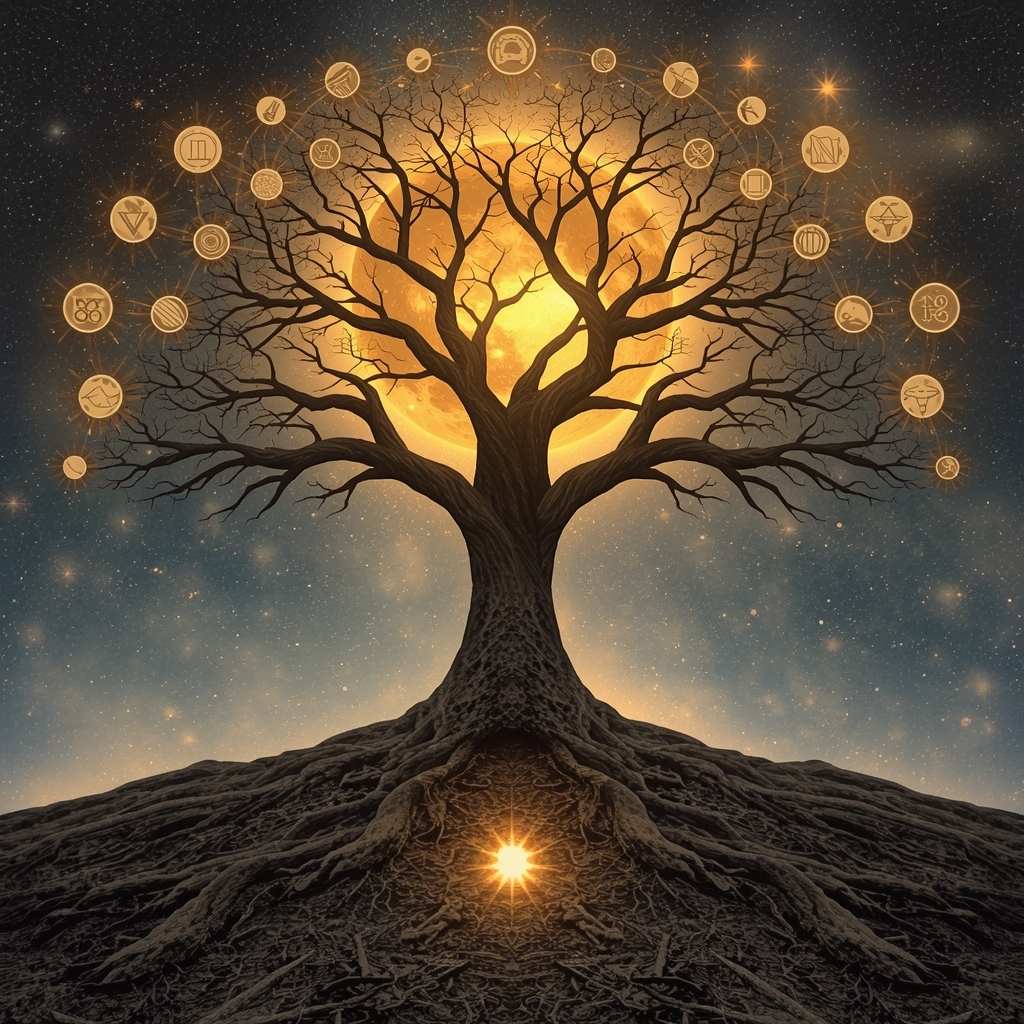
The Tree of Life is a central diagram in Kabbalah, the Jewish mystical tradition. It is usually shown as ten sephirot, or divine qualities, connected by twenty-two paths. These sephirot describe how divine reality becomes progressively more knowable, structured, relational, psychological, and embodied.
The Tree can be read cosmologically, as a map of creation; psychologically, as a map of the soul; ethically, as a map of balance; ritually, as a guide to contemplative practice; and symbolically, as a way to understand the relationship between unity and multiplicity. Later Hermetic, Christian, magical, and esoteric traditions adapted the Tree in their own ways, sometimes very creatively, sometimes controversially.
For modern readers, the Tree is most useful when handled with respect. It is not an occult filing cabinet for collecting correspondences, nor a shortcut to spiritual authority. It is a disciplined symbolic system rooted in Jewish mysticism and later expanded through Western esotericism. Its purpose is not spiritual decoration. Its purpose is integration: to bring crown and kingdom, spirit and matter, mercy and severity, masculine and feminine, self and world back into relationship.
Primary Sources and Traditions Discussed
- Jewish Kabbalah: the sephirot, Shekhinah, Four Worlds, tikkun, the Zohar, Sefer Yetzirah, and Lurianic cosmology.
- Sefer Yetzirah: the thirty-two paths of wisdom, ten sephirot, and twenty-two Hebrew letters.
- Zoharic tradition: symbolic reading, divine emanation, Shekhinah, mystical Torah, and the relational life of the divine.
- Lurianic Kabbalah: contraction, breaking of the vessels, scattered sparks, and tikkun, the repair of the world.
- Hermetic Qabalah: later Western esoteric adaptation of the Tree through Renaissance magic, Rosicrucianism, the Golden Dawn, Tarot, astrology, and ritual practice.
- Comparative symbolism: cautious parallels with the subtle body, chakra systems, Christian mysticism, alchemy, and contemplative psychology.
- Modern interpretation: psychological, ethical, ecological, and spiritual readings of the Tree as a map of balance and repair.
How to Read This Article
This article treats the Tree of Life as a sacred symbolic system, not as a scientific diagram or a universal key that overrides every tradition. Some claims are historical. Some are theological. Some belong to Jewish mysticism. Some come from later Hermetic Qabalah. Some are contemplative and psychological interpretations.
Those distinctions matter. The Tree is rooted in Jewish Kabbalah, and Jewish tradition should not be flattened into generic occultism. At the same time, the Tree has also travelled widely through Western esoteric systems, where it has been read alongside Tarot, astrology, alchemy, Christian mysticism, and modern psychology. This article acknowledges both the Jewish root and the later esoteric branches.
Read the correspondences as contemplative tools, not as rigid facts. A sephirah is not simply a chakra, a planet, an organ, a Tarot card, or a psychological function. It may resonate with those things in later systems, but it is not reducible to them. The Tree is not a cage for meaning. It is a living pattern of relation.
Table of Contents
- The Ten Sephirot and the Hidden Depth
- The Four Worlds: Where the Tree Takes Root
- The Lightning Flash: The Path of Emanation
- The Middle Pillar: Balance and Integration
- The Pillars of Force, Form, and Equilibrium
- The Twenty-Two Paths: Letters of the Soul
- As Above, So Below: The Body as Tree
- The Shekhinah and the Feminine Divine
- The Practice: Working With the Tree
- The Shadow Side: When the Tree Becomes a Cage
- Tikkun: The Repair of the World
- The Tree in History
- The Invitation
- Related Glossary Terms
- Read Next
- Frequently Asked Questions
- Further Reading
- References and Sources
The Ten Sephirot and the Hidden Depth
At the heart of the Tree stand ten sephirot. The word sephirot can be translated in different ways, including numbers, emanations, vessels, or divine qualities. They are not physical places. They are modes by which the hidden divine becomes increasingly knowable, ordered, relational, and manifest.
One way to read the sephirot is as a descent from mystery into form. Another is to read them as an ascent from embodied life back toward source. A third is to read them as psychological functions: will, wisdom, understanding, mercy, severity, beauty, endurance, splendour, foundation, and kingdom. All three readings can coexist, provided they are held carefully.
Keter: Crown
Keter, the Crown, stands at the top of the Tree. It is the first point of emanation, the hidden will before form, the threshold between the unknowable divine and the beginning of manifestation. It is not a personal achievement to be collected. It is a direction of orientation, a symbol of source.
Contemplatively, Keter represents the silence before thought, the pure impulse before intention becomes plan, word, or action. It is the summit that cannot be possessed without becoming something lower than itself.
Chokmah and Binah: Wisdom and Understanding
Chokmah is Wisdom: flash, seed, impulse, insight, overflowing force. Binah is Understanding: form, womb, structure, limitation, comprehension. Together they are often read as cosmic parents, the dynamic polarity through which creative possibility becomes intelligible.
In human life, Chokmah is the lightning of insight that arrives before explanation. Binah is the slow shaping of that insight into form. Chokmah says yes before the sentence exists. Binah gives the sentence grammar.
Daat: Hidden Knowledge
Daat, Knowledge, is often treated as a hidden or quasi-sephirah. It does not appear in every diagram and should not be handled as a simple eleventh sephirah. It marks a threshold: the place where wisdom and understanding become interior knowing.
Daat is not information. It is recognition. It appears when the knower and the known are no longer entirely separate. In contemplative terms, it is the moment when what was studied becomes seen, and what was seen becomes lived.
Chesed and Gevurah: Mercy and Severity
Chesed is mercy, expansion, generosity, blessing, overflow, and the spacious yes of divine giving. Gevurah is severity, strength, boundary, discipline, justice, and the necessary no that protects form from collapse.
Neither is complete without the other. Chesed without Gevurah becomes indulgence, shapelessness, and sentimentality. Gevurah without Chesed becomes cruelty, rigidity, and frozen judgment. Spiritual maturity requires generosity with boundaries and discipline with mercy.
Tiferet: Beauty and the Heart
Tiferet is Beauty, harmony, integration, and the heart of the Tree. It mediates between above and below, right and left, mercy and severity. It is often associated in Christian esoteric readings with the Christic centre, not as a replacement for Jewish meaning, but as a later symbolic resonance in Hermetic and Christian Kabbalah.
Tiferet is not surface prettiness. It is coherence. It is the beauty that appears when contradiction is brought into living relation. In the soul, it is the beginning of integration after fragmentation.
Netzach and Hod: Endurance and Splendour
Netzach is endurance, victory, desire, emotion, vitality, devotion, and the force that persists. Hod is splendour, language, intellect, form, ritual, pattern, and the precision that makes communication possible.
Netzach gives life force. Hod gives articulation. Netzach sings before it explains. Hod writes the music down. When they are balanced, feeling and form cooperate. When they split, emotion becomes chaos or intellect becomes sterile performance.
Yesod: Foundation
Yesod is Foundation. It gathers and transmits the energies of the Tree into Malkuth. It is often linked with dream, imagination, symbol, sexuality, memory, the subtle body, and the lunar field of images that mediates between invisible pattern and visible form.
In practice, Yesod is where inner images become powerful. It is the psychic transformer station, where meaning gathers before entering action. If Yesod is distorted, fantasy, projection, and confusion can dominate. If Yesod is clear, symbol becomes guidance rather than fog.
Malkuth: Kingdom
Malkuth is Kingdom: the physical world, the body, the earth, action, manifestation, ordinary life, and the final receiving vessel of the Tree. It is not spiritually inferior because it is low on the diagram. It is the completion of the circuit.
Many spiritual systems become distorted when they despise Malkuth. Kabbalah does not allow that escape so easily. The divine is not fulfilled by remaining abstract. The Tree must touch ground. Prayer must become action. Insight must become conduct. Spirit must become life.
The Four Worlds: Where the Tree Takes Root
The Tree is often understood through the Four Worlds: Atziluth, Briah, Yetzirah, and Assiah. These are not planets or physical locations. They are levels of manifestation, each expressing divine reality with increasing density and differentiation.
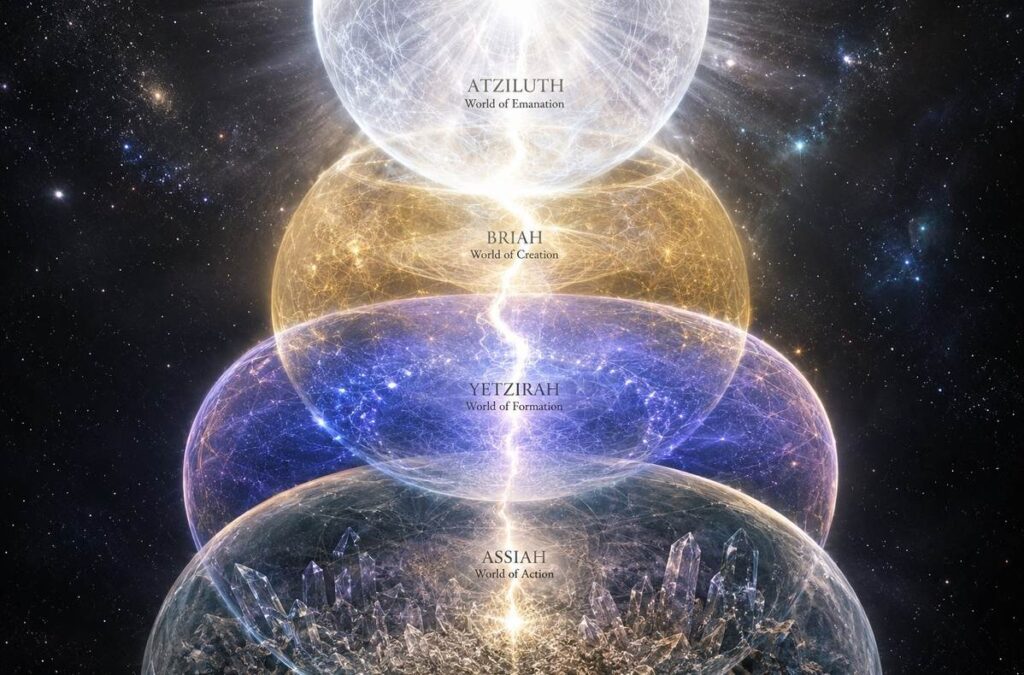
Atziluth: Emanation
Atziluth, the World of Emanation, is the level of pure divine nearness. Here the sephirot are understood as divine qualities in their most subtle form. This is not yet ordinary creation. It is the fire before the flame becomes visible.
Briah: Creation
Briah, the World of Creation, is the level where divine possibility begins to become cosmic architecture. It is associated with archetypal intelligence, throne imagery, and the great structures through which creation becomes intelligible.
Yetzirah: Formation
Yetzirah, the World of Formation, is the level of shaping, image, angelic force, emotion, imagination, and subtle pattern. This is where possibility takes texture, rhythm, and symbolic form before becoming fully material.
Assiah: Action
Assiah, the World of Action, is the manifest world: physical embodiment, earth, action, consequence, and ordinary reality. Assiah is not a failure of spirit. It is where the hidden becomes visible and where repair must actually be practised.
Every real transformation must pass through all four worlds. An insight in Atziluth must become understanding in Briah, image and feeling in Yetzirah, and action in Assiah. Otherwise it remains beautiful vapour.
The Lightning Flash: The Path of Emanation
The sephirot unfold through a pattern often called the Lightning Flash, tracing descent from Keter to Malkuth. This path moves from crown to wisdom, understanding, mercy, severity, beauty, endurance, splendour, foundation, and kingdom.
As symbolism, the Lightning Flash describes how a hidden impulse becomes manifest. First comes will, then insight, then form, then expansion, then limitation, then harmony, then desire, then articulation, then subtle foundation, then action. Creation is not a single leap. It is a sequence of transformations.
This matters spiritually because many people try to manifest insight without passing through the full Tree. They receive an intuition but do not give it form. They feel passion but do not discipline it. They imagine action but do not embody it. The Tree teaches process. Every level must be honoured, or the current shorts out.
The Middle Pillar: Balance and Integration
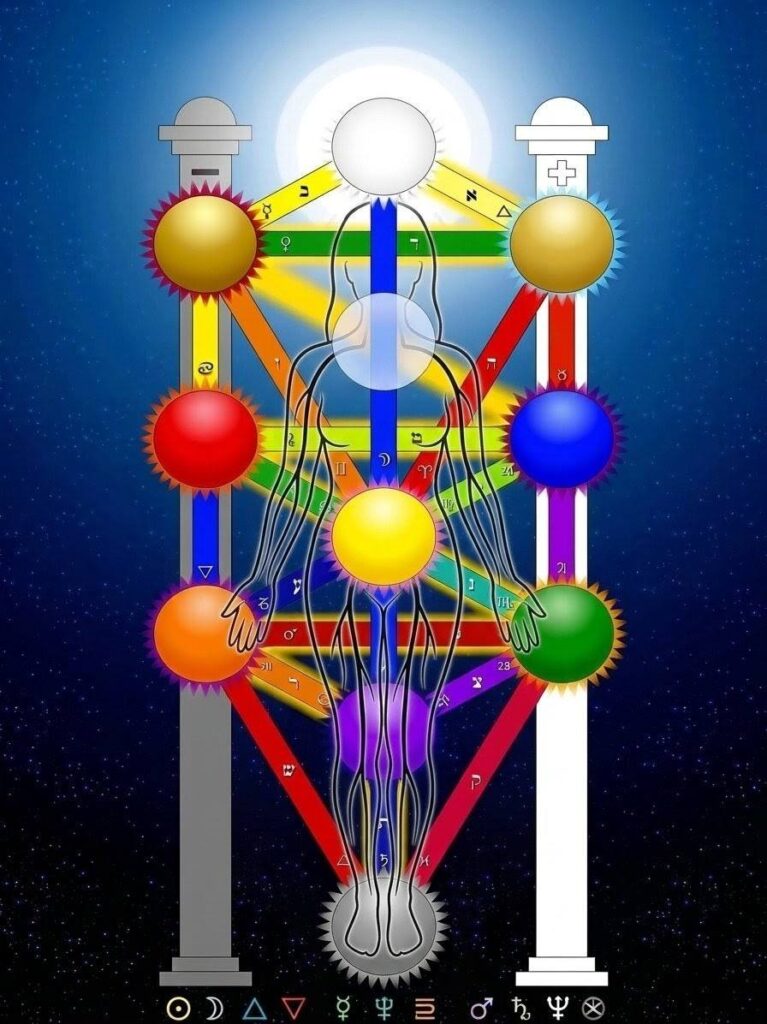
The Middle Pillar usually contains Keter, Daat, Tiferet, Yesod, and Malkuth. It is the central column of equilibrium, linking source, hidden knowledge, heart, foundation, and kingdom. It does not erase the side pillars. It reconciles them.
The Middle Pillar is where opposites are no longer merely fought or alternated. Mercy and severity, expansion and contraction, force and form, insight and embodiment begin to become one living current.
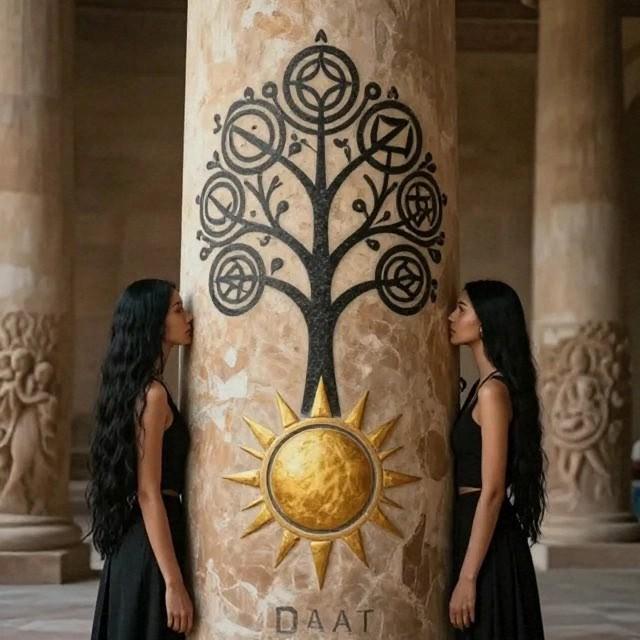
Later esoteric systems often compare the Middle Pillar to the central channel of the subtle body. This comparison can be fruitful if handled as correspondence, not equivalence. The Tree is not simply the chakra system in Hebrew clothing. But both systems recognise a central path through which spiritual energy, attention, and integration move.
The Pillars of Force, Form, and Equilibrium
The Tree is structured around three pillars. The right pillar is often associated with expansion, mercy, force, flow, and generosity. The left pillar is associated with contraction, severity, form, boundary, and discrimination. The middle pillar reconciles them.
The right pillar includes Chokmah, Chesed, and Netzach. It gives movement, desire, generosity, vitality, and overflowing force. Without balance, it can become excess, sentimentality, lack of boundary, or inflation.
The left pillar includes Binah, Gevurah, and Hod. It gives structure, discipline, clarity, language, judgment, and form. Without balance, it can become harshness, sterility, perfectionism, or spiritual bureaucracy.
The middle pillar teaches that spiritual maturity is not choosing one side forever. It is learning when to expand and when to contract, when to give and when to restrain, when to speak and when to remain silent, when to build and when to release.
The Tree does not ask you to choose between mercy and severity. It asks you to become capable of their right relationship.
The Twenty-Two Paths: Letters of the Soul
The ten sephirot are joined by twenty-two paths, commonly associated in Sefer Yetzirah with the twenty-two Hebrew letters. Later Hermetic Qabalah also links these paths with Tarot, astrology, and other symbolic systems. These later correspondences are influential, but they should be distinguished from earlier Jewish sources.
Each path can be read as a transition between states of consciousness. To move from Malkuth to Yesod is not the same as moving from Yesod to Hod or from Tiferet to Keter. Each path has its own quality, test, symbol, and transformation.
Pathworking and Discernment
In Hermetic and modern esoteric practice, pathworking means meditating on a path of the Tree through image, letter, colour, symbol, sound, and guided inner journey. It can be psychologically powerful. It can also become fantasy if not grounded in ethics, tradition, and ordinary life.
The safest way to approach pathworking is with humility. Begin with study. Work slowly. Keep a journal. Do not inflate every image into revelation. Ask what the practice produces in conduct: more clarity, compassion, responsibility, and steadiness, or more grandiosity and escape?
As Above, So Below: The Body as Tree
The Tree has often been mapped onto the human body, especially in later esoteric and Hermetic systems. Malkuth may be associated with feet and earth. Yesod with generative force and the subtle foundation. Tiferet with the heart. Keter with crown. The pillars may be associated with right and left sides of the body, and the middle pillar with the spine or central channel.
These correspondences are contemplative maps, not medical anatomy. They help the practitioner feel the Tree as embodied rather than purely conceptual. The aim is not to prove that every organ corresponds neatly to a sephirah. The aim is to remember that mystical ascent must pass through the body, not escape it.
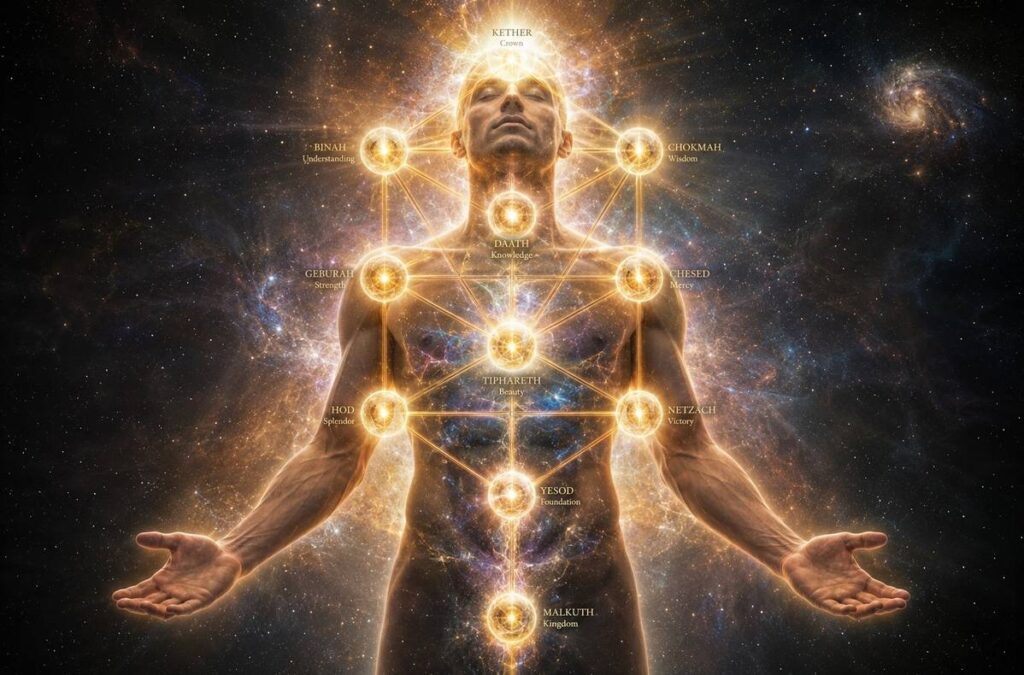
Adam Kadmon
In Kabbalistic thought, Adam Kadmon is the primordial human, a vast symbolic figure through whom divine emanation is imagined. This is not merely a giant person in the sky. It is a way of saying that the human form can reflect cosmic structure, and that the cosmos itself can be imagined through the template of divine humanity.
For contemplative practice, Adam Kadmon reminds us that the human being is not trivial. The body is not an error. Human life is a site where divine pattern can become conscious, ethical, and embodied.
The Shekhinah and the Feminine Divine
No serious account of the Tree can ignore the Shekhinah, the indwelling divine presence. In Kabbalistic symbolism, the Shekhinah is often associated with Malkuth, divine immanence, the Sabbath bride, the feminine aspect of the divine presence, and the presence of God dwelling with creation.
The Shekhinah prevents spirituality from floating away into abstraction. She is the divine as near, dwelling, exiled, hidden, intimate, and present in the world. If Keter suggests the unreachable crown, Shekhinah reminds us that the divine also seeks dwelling below.
The exile of the Shekhinah is one of Kabbalah’s great images of rupture. It can be read cosmologically, theologically, psychologically, and ecologically. Spirit has been separated from matter. Transcendence has been split from immanence. The feminine has been subordinated. The world has been treated as spiritually expendable. Repair requires return.
To restore the Shekhinah is to honour the sacred in earth, body, relationship, justice, community, Sabbath, beauty, and ordinary life. This is not only mystical. It is ethical. The divine presence is not restored by vision alone. It is restored by how one lives.
The Practice: Working With the Tree
To work with the Tree is not simply to memorise correspondences. It is to let the Tree become a mirror. Where are you excessive? Where are you deficient? Where is mercy needed? Where is boundary needed? Where is the heart missing? Where has imagination become fog? Where has earth been neglected?
Begin in Malkuth
Begin with Malkuth: body, earth, schedule, ethics, food, sleep, work, home, money, speech, responsibility. The Tree does not ask the seeker to escape ordinary life. It asks them to make ordinary life transparent to deeper order.
A grounded practice may include walking, body awareness, honest work, keeping promises, caring for the home, and noticing how spiritual ideas behave when tested by daily life. Malkuth is where everything becomes real enough to matter.
Work Slowly Through the Sephirot
Study one sephirah at a time. Read its traditional meanings. Notice how it appears in your life. Ask what balanced expression looks like. Ask what excess looks like. Ask what deficiency looks like. Use meditation, journalling, prayer, ritual, or contemplative reading to deepen attention.
Do not rush toward the supernals. Keter without Malkuth becomes spiritual inflation. Wisdom without ethics becomes manipulation. Understanding without compassion becomes cold architecture. The Tree is not climbed by ambition. It is integrated by reverent attention.
Pathworking With Care
Pathworking can be useful when approached gradually. Visualise the Tree. Choose a path. Work with its symbols. Journal carefully. Keep the body grounded. End practices with ordinary actions: drink water, eat, walk, speak to someone trustworthy, clean the room.
Advanced ritual, intense visualisation, or prolonged mystical work can destabilise some people, especially those with trauma histories, dissociation, mania, psychosis, or severe anxiety. The Tree is beautiful, but beauty is not a substitute for pacing, support, and discernment.
The Shadow Side: When the Tree Becomes a Cage
Every spiritual map has a shadow. The Tree can become a tool of integration, but it can also become a cage. The first danger is reification: mistaking the diagram for reality. The Tree points. It does not imprison the divine inside ten labels and twenty-two lines.
The second danger is correspondence addiction. Some seekers become so obsessed with whether a sephirah corresponds to a chakra, planet, Tarot card, angel, colour, metal, incense, herb, or psychological function that the living work disappears. The filing cabinet grows ornate. The soul remains unchanged.
The third danger is premature transcendence. Some people try to leap into Keter while their Malkuth is in ruins. They seek supernal states while avoiding money, body, trauma, ethics, relationships, anger, grief, or accountability. This is not ascent. It is escape wearing ceremonial robes.
The fourth danger is spiritual pride. Understanding the Tree conceptually is not the same as embodying it. The Tree is not a credential. It is a mirror. If it does not make the practitioner more truthful, grounded, compassionate, discerning, and responsible, it has not yet been understood.
Tikkun: The Repair of the World
One of the most powerful developments in Kabbalistic thought appears in Lurianic Kabbalah: the myth of Shevirat ha-Kelim, the Breaking of the Vessels. In this symbolic cosmology, divine light was too intense for the vessels meant to receive it. The vessels shattered, scattering holy sparks throughout creation.
Tikkun means repair. The task of human life becomes the gathering and raising of scattered sparks through prayer, ethical action, mitzvot, contemplative intention, justice, and conscious living. The world is not merely endured until escape. It is repaired.
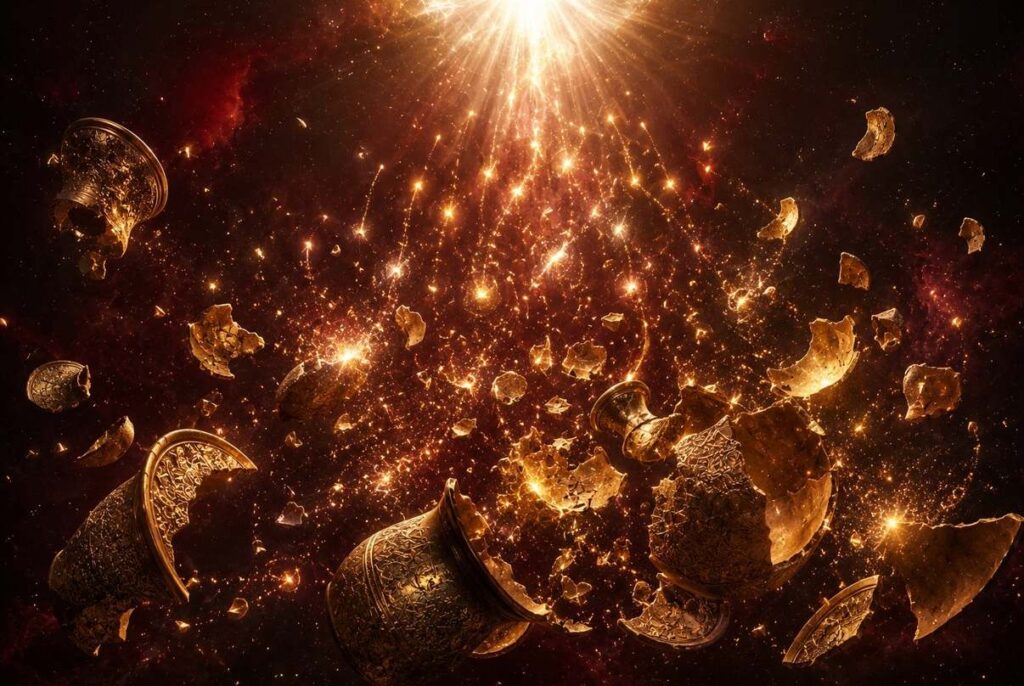
This teaching gives the Tree its moral force. Mysticism is not only inward ascent. It is participation in repair. A kind word, a truthful act, a repaired relationship, a protected ecosystem, a just decision, a Sabbath kept with reverence, a body treated with care: each may become part of tikkun.
The broken vessels are not merely elsewhere. They are in the psyche, in culture, in religious history, in ecological devastation, in fractured attention, in the exile of the body, and in the split between spirit and matter. Repair begins wherever the spark is recognised.
The Tree in History
The Tree of Life did not descend fully formed into modern occult books. Its roots are complex. Sefer Yetzirah, the Book of Formation, is one of the earliest and most important texts associated with the ten sephirot and twenty-two Hebrew letters. Scholars generally date its composition or redaction to late antiquity or the early medieval period, though traditional attributions reach much further back.
The Zohar, the central masterpiece of medieval Kabbalah, emerged in thirteenth-century Spain and is associated historically with Moses de León, though traditional accounts attribute it to Rabbi Shimon bar Yochai. Modern scholarship and traditional belief differ on authorship and dating. Both facts should be acknowledged rather than blurred.
In sixteenth-century Safed, Isaac Luria and his circle developed a profound mythic cosmology of contraction, breaking, sparks, and repair. This Lurianic vision reshaped Kabbalah and gave later Jewish mysticism one of its most dynamic accounts of cosmic rupture and human responsibility.
From Jewish Kabbalah, the Tree also entered Christian Kabbalah and later Hermetic Qabalah. Renaissance thinkers, Rosicrucians, Freemasons, Theosophists, Golden Dawn magicians, Tarot writers, and modern occultists adapted it extensively. These adaptations can be illuminating, but they are not identical with Jewish Kabbalah. Roots and branches should both be named.
Kabbalah and Modern Science
Modern readers often notice resonances between Kabbalistic symbolism and contemporary physics: hidden unity, emanation, energy, pattern, relationality, emptiness, and the mysterious role of observation. These parallels can be suggestive, but they should not be overstated.
Quantum physics does not prove the Tree of Life. Kabbalah does not need to be validated by physics in order to matter. The better approach is contemplative humility: ancient symbolic systems and modern science ask different kinds of questions, but both can unsettle the assumption that reality is flat, dead, and easily possessed by the mind.
The Invitation
The Tree of Life stands before the reader as map, mirror, ladder, garden, body, cosmos, and question. It does not offer quick enlightenment. It does not flatter spiritual impatience. It asks for study, reverence, patience, and repair.
Every sephirah asks something. Keter asks orientation. Chokmah asks openness. Binah asks form. Chesed asks generosity. Gevurah asks boundary. Tiferet asks integration. Netzach asks endurance. Hod asks clarity. Yesod asks purified imagination. Malkuth asks embodiment.
The Tree is not somewhere else. It is not merely on the page. It is in speech, breath, conduct, dream, love, justice, body, grief, discipline, and the way the ordinary world begins to shine when it is no longer treated as spiritually empty.
Approach the Tree as ornament, and it becomes another elegant diagram. Approach it as practice, and the diagram becomes a door.
Related Glossary Terms
These terms help clarify the Kabbalistic, esoteric, and contemplative framework of the Tree of Life:
- Kabbalah: Jewish mystical tradition concerned with divine emanation, scripture, creation, the soul, and the hidden life of God.
- Tree of Life: diagram of ten sephirot and twenty-two paths mapping divine emanation, creation, consciousness, and return.
- Sephirot: divine qualities, vessels, or emanations through which the infinite becomes knowable and manifest.
- Ein Sof: the infinite, unknowable divine beyond all sephirot and names.
- Keter: Crown, the first sephirah and symbol of divine will or source.
- Chokmah: Wisdom, the flash of creative insight and dynamic force.
- Binah: Understanding, the womb of form, structure, and comprehension.
- Daat: hidden knowledge, threshold of recognition where wisdom and understanding become interior knowing.
- Chesed: mercy, expansion, generosity, and loving overflow.
- Gevurah: severity, boundary, strength, discipline, and judgment.
- Tiferet: beauty, harmony, heart, integration, and mediated balance.
- Netzach: endurance, victory, desire, emotion, and vital persistence.
- Hod: splendour, language, intellect, form, ritual, and articulation.
- Yesod: foundation, dream, symbol, subtle body, and transmission into manifestation.
- Malkuth: kingdom, earth, body, action, and manifested reality.
- Shekhinah: indwelling divine presence, often associated with Malkuth and divine immanence.
- Tikkun: repair, restoration, and the ethical-spiritual work of healing rupture.
- Shevirat ha-Kelim: Breaking of the Vessels in Lurianic Kabbalah.
- Four Worlds: Atziluth, Briah, Yetzirah, and Assiah, levels of emanation, creation, formation, and action.
- Hermetic Qabalah: Western esoteric adaptation of Kabbalah through Christian, magical, occult, Tarot, and alchemical systems.
Read Next
For the strongest next step, continue into the hidden language of scripture and layered interpretation:
The Hidden Language of the Bible: Decoding Esoteric Christianity and Allegorical Scripture
This companion article explores Pardes, allegory, mystical reading, biblical symbolism, and scripture as a technology of consciousness.
Frequently Asked Questions
What is the Kabbalistic Tree of Life?
The Kabbalistic Tree of Life is a symbolic diagram of ten sephirot connected by twenty-two paths. In Jewish Kabbalah, it describes divine emanation, creation, the soul, and the relationship between the infinite and the manifest world. Later Hermetic Qabalah also uses the Tree as a map of consciousness, ritual, Tarot, astrology, and spiritual development.
What are the ten sephirot?
The ten sephirot are Keter, Chokmah, Binah, Chesed, Gevurah, Tiferet, Netzach, Hod, Yesod, and Malkuth. They can be understood as divine qualities, vessels, or emanations through which the infinite becomes knowable and manifest. They also function as psychological and contemplative symbols when used carefully.
What are the Four Worlds in Kabbalah?
The Four Worlds are Atziluth, the World of Emanation; Briah, the World of Creation; Yetzirah, the World of Formation; and Assiah, the World of Action. They describe levels through which divine reality becomes increasingly formed, symbolic, emotional, and manifest. Transformation must eventually pass into Assiah, ordinary action and embodied life.
What is the Shekhinah?
The Shekhinah is the indwelling divine presence. In Kabbalistic symbolism, she is often associated with Malkuth, divine immanence, the Sabbath bride, and the presence of God dwelling with creation. Her exile symbolises rupture between heaven and earth, spirit and matter, transcendence and immanence. Her restoration is central to the work of repair.
What does tikkun mean?
Tikkun means repair. In Lurianic Kabbalah, it refers to the restoration of cosmic rupture after the Breaking of the Vessels, when divine sparks became scattered throughout creation. Spiritually and ethically, tikkun means participating in repair through prayer, conscious action, justice, compassion, and the restoration of right relationship.
Is the Tree of Life the same as the chakra system?
No. The Tree of Life belongs to Kabbalah, while chakras belong to Indian yogic and Tantric traditions. Later esoteric systems have compared them, and some correspondences can be contemplatively useful, but they are not identical systems. Responsible comparison honours the difference between traditions rather than collapsing one into the other.
How can I begin working with the Tree of Life safely?
Begin with study, grounding, and ethical practice. Learn the sephirot slowly. Notice how mercy, severity, beauty, foundation, and kingdom appear in ordinary life. Keep practices embodied and balanced. Avoid rushing into intense ritual or pathworking if you are unstable, dissociated, manic, traumatised, or psychologically distressed. The Tree should deepen responsibility, not inflate the ego.
Study Note: This article explores Kabbalah, Hermetic Qabalah, Jewish mysticism, esoteric symbolism, and contemplative practice for educational and reflective purposes. It does not provide theological, pastoral, psychological, medical, or spiritual-direction advice. Kabbalah is rooted in Jewish tradition and should be approached with respect, not as a loose collection of occult correspondences. Intensive pathworking, ritual, meditation, or mystical practice can destabilise some people. If practice produces anxiety, obsession, grandiosity, dissociation, mania, spiritual crisis, or psychological distress, pause the work and seek support from qualified mental health professionals, trusted pastoral care, or trauma-informed spiritual guidance.
Further Reading
These related articles continue the themes of Kabbalah, sacred language, body symbolism, esoteric Christianity, consciousness, and spiritual repair:
- The Hidden Language of the Bible: Decoding Esoteric Christianity and Allegorical Scripture – Pardes, layered interpretation, scripture, symbol, and the Bible as a technology of consciousness.
- The Divine Architecture Within: How Your Body Mirrors the Universe – Body symbolism, microcosm and macrocosm, subtle anatomy, and embodied correspondence.
- The Four Elements of Consciousness: Earth, Water, Fire, Air and the Fifth – Elemental symbolism as a map of psyche, body, transformation, and spiritual balance.
- The Mental Plane Explained: Where Thoughts Become Reality – Thought, imagination, symbol, and the subtle level where inner pattern becomes experience.
- The Power of Words: Etymology, Conscious Language, and the Magic of Speech – Language, naming, blessing, curse, sacred speech, and the creative responsibility of words.
- The Shem HaMeforash: God’s Explicit Name and the 72-Fold Secret – Divine names, Exodus, sacred letters, and the Jewish tradition of hidden name theology.
- The Language of the Birds: 7 Traditions on Divine Speech – Sacred sound, symbolic speech, divine language, and hidden communication across traditions.
- John Dee’s Mathematical Preface 1570: Occult Foundation of Renaissance Magic – Sacred mathematics, Renaissance esotericism, geometry, and hidden architecture.
- States of Knowing: What Happens When Consciousness Unravels – Altered states, spiritual destabilisation, mystical knowing, and the need for grounded integration.
- The Living Thread: How Forbidden Knowing Survives – How hidden knowledge survives through symbol, scripture, practice, lineage, and repair.
References and Sources
The following sources support the Kabbalistic, historical, esoteric, and comparative framework used in this article.
Primary Kabbalistic Texts
- Sefer Yetzirah, the Book of Formation. Foundational text on ten sephirot, twenty-two Hebrew letters, and the thirty-two paths of wisdom.
- Zohar, the Book of Splendour. Central medieval Kabbalistic text, traditionally attributed to Rabbi Shimon bar Yochai and historically associated with thirteenth-century Spain.
- Lurianic Kabbalah. Teachings associated with Isaac Luria and his circle in sixteenth-century Safed, especially contraction, Breaking of the Vessels, sparks, and tikkun.
- Bahir. Early Kabbalistic text important for the development of sephirotic symbolism.
Jewish Mysticism and Scholarship
- Scholem, Gershom. (1941). Major Trends in Jewish Mysticism. New York: Schocken.
- Scholem, Gershom. (1965). On the Kabbalah and Its Symbolism. New York: Schocken.
- Scholem, Gershom. (1974). Kabbalah. New York: Meridian.
- Matt, Daniel C., trans. (2004-2017). The Zohar: Pritzker Edition. Stanford: Stanford University Press.
- Idel, Moshe. (1988). Kabbalah: New Perspectives. New Haven: Yale University Press.
- Wolfson, Elliot R. (1994). Through a Speculum That Shines: Vision and Imagination in Medieval Jewish Mysticism. Princeton: Princeton University Press.
- Green, Arthur. (1997). These Are the Words: A Vocabulary of Jewish Spiritual Life. Woodstock: Jewish Lights.
- Fine, Lawrence. (2003). Physician of the Soul, Healer of the Cosmos: Isaac Luria and His Kabbalistic Fellowship. Stanford: Stanford University Press.
Hermetic Qabalah and Western Esotericism
- Fortune, Dion. (1935). The Mystical Qabalah. London: Williams and Norgate.
- Regardie, Israel. (1932). A Garden of Pomegranates. London: Rider.
- Regardie, Israel. (1932). The Tree of Life. London: Rider.
- Halevi, Z’ev ben Shimon. (1972). The Tree of Life: An Illustrated Study in Magic. London: Rider.
- Yates, Frances A. (1964). Giordano Bruno and the Hermetic Tradition. Chicago: University of Chicago Press.
- Hanegraaff, Wouter J. (2012). Esotericism and the Academy: Rejected Knowledge in Western Culture. Cambridge: Cambridge University Press.
Comparative Symbolism and Contemplative Practice
- Matt, Daniel C. (1996). God and the Big Bang: Discovering Harmony between Science and Spirituality. Woodstock: Jewish Lights.
- Jung, C. G. (1968). Psychology and Alchemy. Collected Works, Vol. 12. Princeton: Princeton University Press.
- Corbin, Henry. (1969). Creative Imagination in the Sufism of Ibn ‘Arabi. Princeton: Princeton University Press.
- Feuerstein, Georg. (1998). The Yoga Tradition: Its History, Literature, Philosophy and Practice. Prescott: Hohm Press.