
Neo Gnosticism and Christianity: Jesus, Revelation and Hidden Teaching
Neo Gnosticism and Christianity stand close together, but not neatly inside one another. Neo Gnosticism reads Jesus, revelation and salvation through the lens of direct knowing rather than obedience to external authority. This raises an immediate question for many readers: is Neo Gnosticism Christian, anti-Christian, post-Christian, or something else entirely? The answer is not simple. Neo Gnosticism often draws from early Christian Gnostic texts, especially those centred on Jesus, but it does not usually accept later church authority, creedal boundaries or institutional Christianity as the final measure of truth.
This comparison is not an attack on Christianity. Ancient Gnostic texts belong within the wider early Christian and late antique religious world, while Neo Gnosticism is a modern interpretive route shaped by those texts, contemporary scholarship, psychology, contemplative practice and spiritual search. Christianity is not one single thing across all time. Ancient Gnostic movements were often deeply engaged with Christian language. Many Gnostic texts place Jesus at the centre. Neo Gnosticism often reinterprets Jesus rather than rejecting him. The comparison focuses on patterns, not personal faith.
In Plain Terms
Neo Gnosticism is related to Christianity, but it is not identical with mainstream Christianity. It often reads Jesus as a revealer of direct knowing: one who awakens the hidden light within the human being, discloses the deeper structure of reality and questions false authority. Some Neo Gnostics identify as Christian or Gnostic Christian. Others read Christian and Gnostic sources outside church identity.
The important distinction is this: Neo Gnosticism does not usually measure truth by church authority alone. It asks whether a teaching awakens recognition, deepens discernment and returns the reader to direct knowing. That makes its relationship to Christianity close, complicated and often fertile.
Primary Sources and Traditions Discussed
- The Gospel of Thomas: a sayings gospel centred on the living Jesus, inner recognition and the kingdom already present.
- The Gospel of Philip: a Valentinian-leaning text concerned with sacraments, names, images, bridal chamber symbolism and transformed perception.
- The Apocryphon of John: a revealed cosmology in which the risen Christ discloses the origin of the world, the archons and the divine spark.
- The Gospel of Truth: a Valentinian meditation on error, recognition, restoration and the saving disclosure of truth.
- The Gospel of Mary: an early Christian text associated with Mary Magdalene, inner vision, ascent and conflict over spiritual authority.
- Early Christianity: the diverse first centuries in which many communities interpreted Jesus, scripture, revelation and salvation in different ways.
- Christian mysticism: apophatic prayer, inner transformation, union with divine life and discernment of spirits within Christian frames.
- Neo Gnosticism: modern reinterpretation of ancient Gnostic themes through direct knowing, contemplative practice, psychology and comparative reading.
How to Read This Article
This comparison brings traditions and patterns into dialogue. It does not claim that Neo Gnosticism is the “real Christianity”, nor that mainstream Christianity is false. Ancient Gnostic texts belong within the wider early Christian and late antique religious world, while Neo Gnosticism is a modern interpretive route shaped by those texts, scholarship, psychology, contemplation and spiritual searching.
Read the comparisons as lenses rather than verdicts. Christianity is not one single thing across all time, and Neo Gnosticism has no single central authority. The question is not which label wins. The question is how Jesus, revelation, scripture, authority and direct knowing are understood in each frame.
Table of Contents
- In Plain Terms
- Primary Sources and Traditions Discussed
- How to Read This Article
- Is Neo Gnosticism Christian?
- The Short Answer
- Why Jesus Matters in Gnostic Texts
- Jesus as Saviour and Jesus as Revealer
- Hidden Teaching and Direct Knowing
- The Gospel of Thomas and the Inner Kingdom
- The Gospel of Philip and Sacramental Mystery
- The Apocryphon of John and Revealed Cosmology
- Where Neo Gnosticism and Christianity Overlap
- Where They Differ
- Church Authority, Scripture and Direct Experience
- Sin, Ignorance and Salvation
- The Cross, Resurrection and Inner Awakening
- Christian Mysticism and Gnostic Recognition
- Is Neo Gnosticism Anti-Christian?
- Neo Gnosticism, Post-Christian Spirituality and the Modern Seeker
- Christianity and Neo Gnosticism Compared
- Common Misunderstandings
- Related Glossary Terms
- Read Next
- Neo Gnosticism Route Box
- Frequently Asked Questions
- Further Reading
- References and Sources
- Study Note

Is Neo Gnosticism Christian?
Neo Gnosticism can be Christian, post-Christian, interfaith, esoteric or independent depending on the practitioner. Some Neo Gnostics see themselves as Gnostic Christians. Others read Gnostic texts outside church identity. Others use Christian symbols as part of a wider contemplative and comparative path. Neo Gnosticism does not have one official relationship to Christianity. It has a family of relationships.
The diversity is not a weakness. It reflects the diversity of the ancient sources themselves. The Nag Hammadi Library contains texts that sound like Christian sermons, Platonic treatises, Jewish apocalypses and Hermetic dialogues. Some ancient Gnostic groups were tightly organised communities. Others were loose networks of readers. The modern scene is similarly varied.
The Short Answer
Neo Gnosticism is related to Christianity, but not identical with mainstream Christianity. It shares Jesus language, revelation, salvation, inner transformation, scripture, concern with false authority and hope of liberation. It often differs over church authority, creeds, sin, salvation, the material world, the role of hidden teaching, the meaning of resurrection, and whether direct knowing can outrank institution.
Why Jesus Matters in Gnostic Texts
Many ancient Gnostic texts are not “non-Christian” in a simple sense. They often place Jesus at the centre as revealer, teacher, spiritual guide or heavenly mediator. Jesus appears not merely as a figure who demands belief, but as one who discloses what has been hidden: the origin of the soul, the nature of the world, the ignorance of the lower powers and the way of return.
The Apocryphon of John opens with a post-resurrection revelation in which Jesus appears to John and unfolds a complete cosmology. The Gospel of Thomas collects sayings attributed to Jesus that point toward inner recognition. The Gospel of Philip describes Jesus as the one who reveals the bridal chamber and the true nature of sacramental union. These texts are not peripheral to Christianity. They are alternative Christianities, deeply engaged with the figure of Jesus but interpreting his significance differently from the traditions that eventually became orthodox.
Jesus as Saviour and Jesus as Revealer
Mainstream Christianity often emphasises Jesus as saviour through incarnation, crucifixion, resurrection, forgiveness of sin and reconciliation with God. Gnostic texts often emphasise Jesus as revealer: one who awakens knowledge, exposes the false order and teaches the soul its origin. This comparison needs nuance.
Gnostic traditions do contain salvation language, but the saving work is often understood through revelation and awakening rather than only legal forgiveness or substitutionary atonement. The Gospel of Truth, a Valentinian text, describes Jesus as the one who restores the lost to the Fullness through the publication of the word. The saving act is the communication of recognisable truth, not merely the execution of a juridical transaction. For many Gnostic readers, Jesus saves by showing, not only by dying.
Hidden Teaching and Direct Knowing
Hidden does not mean gossip, conspiracy or secret trivia. It means teaching not recognised by ordinary consciousness. The hidden teaching is hidden because the reader is asleep, not because the truth is merely locked in a secret vault. In Gnostic reading, hidden teaching is not information withheld from the public. It is truth that cannot be recognised until the reader has been changed enough to receive it.
This is why direct knowing matters so much. Gnosis is not book-learning. It is the recognition of what one already is, obscured by forgetfulness and false identification. Jesus, in this reading, is the one who brings the reminder. The Gospel of Thomas saying 5 captures this: “Recognise what is in your sight, and that which is hidden from you will become plain to you.” The hidden becomes visible not through more data, but through a shift in the perceiver.
The Gospel of Thomas and the Inner Kingdom
The Gospel of Thomas serves as a natural bridge between Christianity and Neo Gnosticism. It contains sayings of Jesus, themes of direct recognition, the kingdom inside and outside, knowing oneself, light within, spiritual poverty and simplicity, and an absence of heavy institutional framing. It reads like a manual of recognition rather than a church charter.
Saying 3 is particularly important: “If those who lead you say to you, ‘See, the kingdom is in the sky,’ then the birds of the sky will precede you. If they say to you, ‘It is in the sea,’ then the fish will precede you. Rather, the kingdom is inside of you, and it is outside of you.” This saying does not reject the world. It relocates the kingdom from a distant place to an immediate presence, accessible through self-knowledge. For Neo Gnostics, this is not a rejection of Christianity but a deepening of it.
The Gospel of Philip and Sacramental Mystery
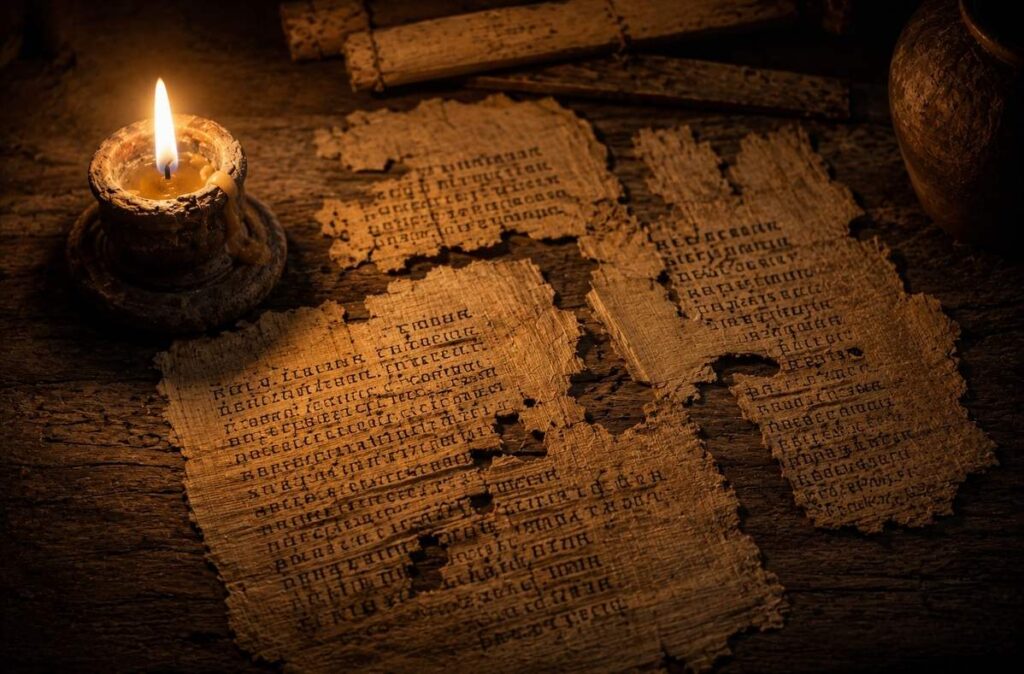
The Gospel of Philip keeps Gnosticism from sounding purely mental. It contains sacraments, the bridal chamber, union, names and reality, truth and image, resurrection as something tasted in life, and embodied and relational dimensions. Philip brings sacrament, relationship, eros and transformation into the Gnostic path.
The text describes the bridal chamber as the holy of holies, a place of sacred union that restores the divided self to its original androgynous wholeness. This is not mere metaphor. For Valentinian readers, the nymphon was a lived sacramental reality. The Gospel of Philip also insists that truth did not come into the world naked, but in symbols and images. This means that the spiritual path is not an escape from matter but a transformation of it. The body is not rejected; it is the vessel through which the bridal chamber is entered.

The Apocryphon of John and Revealed Cosmology
The Apocryphon of John presents a post-resurrection revelation in which Jesus appears to John and unfolds the full cosmic drama: Barbelo, the divine Mother; Sophia, the fallen wisdom; Yaldabaoth, the ignorant creator; the archons, the ruling powers; the origin of the divine spark; and liberation through recognition. It is one of the most comprehensive cosmological texts in the Nag Hammadi Library.
Neo Gnostics may read this myth literally, symbolically, psychologically or metaphysically. What matters is that the text presents Jesus as the one who reveals the hidden architecture of reality. The reader is not asked to believe a doctrine but to recognise a pattern. The Apocryphon of John is not a catechism. It is a map, and the map is only useful if the traveller can read it.
Where Neo Gnosticism and Christianity Overlap
The overlap areas are significant. Both traditions hold that Jesus remains important, that salvation or liberation matters, that inner transformation matters, that scripture matters, that spiritual authority should be questioned, that the world is not simply accepted as spiritually transparent, that prayer, contemplation and ethical transformation may be practised, and that there is concern with false powers and deception.
Christian mysticism provides a particularly strong bridge. Figures such as Pseudo-Dionysius, Meister Eckhart, Gregory of Nyssa and the author of The Cloud of Unknowing describe direct experience of God, inner prayer, apophatic theology, transformation of the heart, union with divine life and discernment of spirits. These themes resonate deeply with Gnostic concerns. The difference is that Christian mysticism usually remains inside the church’s devotional and theological frame, whereas Neo Gnosticism may move outside it or reinterpret it.
Where They Differ
The differences are equally significant. Authority: church versus direct knowing. Sin: moral rebellion versus ignorance, forgetfulness or misrecognition. Salvation: forgiveness and reconciliation versus awakening and return. Scripture: closed canon versus wider source field. Jesus: incarnate Lord versus revealer of gnosis, sometimes both. Body and world: good creation versus mixed, deficient or symbolically veiled cosmos. Doctrine: belief statements versus experiential recognition.
These differences are not trivial. They represent fundamentally different answers to the question of what is wrong with humanity and how it is put right. Christianity often says the problem is sin and the solution is grace. Gnosticism often says the problem is ignorance and the solution is recognition. Both are serious answers. They are not interchangeable, but they are not necessarily enemies either.
Church Authority, Scripture and Direct Experience
Mainstream Christianity often preserves truth through church, tradition, canon, sacrament and communal authority. Neo Gnosticism often tests those structures against direct experience, inner recognition and alternative early texts. Christianity often asks whether an experience is faithful to the tradition. Neo Gnosticism often asks whether the tradition awakens direct knowing.
This does not mean Neo Gnosticism rejects all authority. It means authority is tested differently. The ancient Gnostics had their own teachers, communities and traditions. The modern seeker may read the Nag Hammadi texts alongside the canonical Bible, comparing and weighing rather than simply accepting or rejecting. The question is not whether there is authority, but whether the authority serves awakening or merely preserves power.
Sin, Ignorance and Salvation
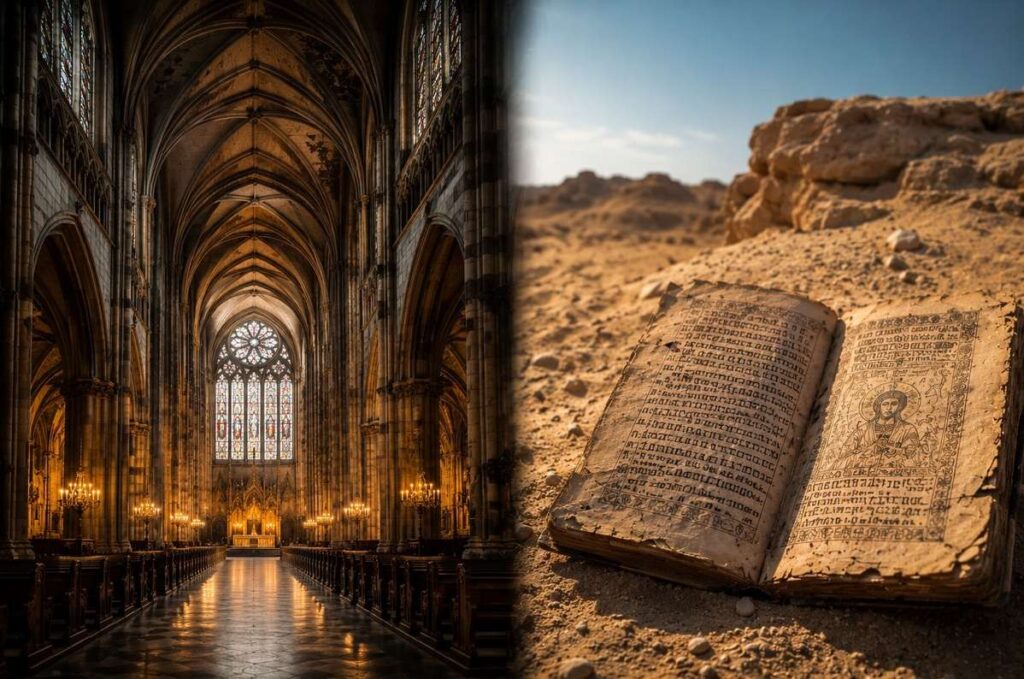
Mainstream Christianity often frames the human problem as sin, estrangement from God, and need for redemption. Gnostic traditions often frame the human problem as ignorance, forgetfulness, captivity to false authority and loss of origin. Modern Neo Gnosticism often interprets salvation as recognition, liberation from false identity and the return of attention to the divine source.
This distinction matters. The Gospel of Truth describes the human condition as a state of error, not primarily as moral failure. The error is like a nightmare from which the sleeper cannot wake because they do not know they are dreaming. Salvation is the moment of waking, the recognition that the terror was never real. This is not a denial of ethics. It is a reframing of the human predicament from juridical to epistemological.
The Cross, Resurrection and Inner Awakening
Neo Gnosticism may not always centre the cross in the same way as mainstream Christianity. Some Gnostic readings emphasise the living Christ, the revealer, or resurrection as present awakening. The Second Treatise of the Great Seth describes the crucifixion as an illusion witnessed by the lower powers, while the true Christ laughs at their ignorance. The Apocalypse of Peter describes the laughing saviour above the cross, indicating that the real Jesus was not the one suffering.
Yet other Gnostic texts, such as the Gospel of Philip, speak of resurrection as something already tasted in life. For many Christians, the cross and resurrection are the centre of salvation history. For many Gnostic and Neo Gnostic readers, they are also symbols of passage: death to false identity, awakening of hidden life and return to the divine origin. The difference is emphasis, not necessarily rejection.
Christian Mysticism and Gnostic Recognition
Christian mysticism offers a significant bridge between the two worlds. Pseudo-Dionysius the Areopagite, writing around 500 CE, described the soul’s ascent through negation and union with the divine darkness. Meister Eckhart (c. 1260-1328) spoke of the birth of God in the soul and the ground of the soul where creature and Creator are one. The Cloud of Unknowing taught a contemplative method of loving attention directed toward God beyond all concepts. Gregory of Nyssa and Evagrius Ponticus developed sophisticated psychologies of spiritual ascent.
These figures share with Gnosticism a concern for direct experience, inner transformation and the limitations of doctrinal language. The careful distinction is that Christian mysticism usually remains inside the church’s devotional and theological frame. Neo Gnosticism may move outside it or reinterpret it. A Christian mystic might say, “I experience God through the church’s sacraments.” A Neo Gnostic might say, “I experience the divine origin through recognition that the church’s sacraments point toward.” The direction is similar. The frame is different.
Is Neo Gnosticism Anti-Christian?
The answer is no. Neo Gnosticism may critique institutional authority, literalism, dogma or church power, but that is not the same as hatred of Christianity. Many Neo Gnostics are deeply interested in Jesus, early Christianity and Christian mystical traditions. The critique is directed at structures, not at the essence of the faith. Some Christian readers will still consider Neo Gnosticism heretical or outside orthodox faith. That is a real theological difference and should not be dismissed.
It is worth noting that the ancient Gnostics did not see themselves as anti-Christian. They saw themselves as the true Christians, the ones who understood the hidden meaning of the teachings. The conflict was not between Christianity and something else. It was between different kinds of Christianity. The modern situation is analogous. Neo Gnosticism is not Christianity’s enemy. It is Christianity’s estranged cousin.
Neo Gnosticism, Post-Christian Spirituality and the Modern Seeker
Modern readers are drawn to Neo Gnosticism for several reasons. They value Jesus but not church authority. They seek direct experience rather than mediated belief. They want access to hidden and early Christian texts that were suppressed or forgotten. They are interested in trauma, psychology and inner transformation. They distrust institutional religion. They want symbolic depth without dogmatic closure.
Many people today have left Christianity not because they reject Jesus, but because they cannot accept the institutional packaging. Neo Gnosticism offers a way to keep the figure of Jesus while releasing the structures that have become problematic. It is not a compromise. It is a different route to the same recognisable territory.

Christianity and Neo Gnosticism Compared
This comparison is not a verdict against either tradition. It shows the different emphases that shape how Jesus, salvation, authority and practice are understood.
| Area | Mainstream Christianity | Neo Gnosticism |
|---|---|---|
| Jesus | Lord, Son of God, saviour and centre of faith. | Revealer of direct knowing, awakener of the hidden light, sometimes also honoured as saviour. |
| Human problem | Sin, estrangement, need for forgiveness and reconciliation. | Ignorance, forgetfulness, captivity to false identity and lower powers. |
| Salvation | Grace, faith, forgiveness, resurrection life and union with God. | Gnosis, recognition, liberation from false authority and return to divine origin. |
| Authority | Scripture, church, tradition, sacrament and doctrine. | Direct knowing, ancient alternative texts, contemplative practice and tested experience. |
| Scripture | The biblical canon as the central scriptural field. | The Bible read alongside Nag Hammadi texts, apocrypha, mystical sources and comparative traditions. |
| World and body | Creation is good but fallen. | The world may be mixed, deficient, veiled or symbolically obscured, while the body remains a field of practice. |
| Hidden teaching | Public gospel entrusted to church and scripture. | Inner teaching recognised through awakening and direct experience. |
| Practice | Prayer, worship, sacraments, ethics and community. | Contemplation, study, discernment, inner recognition and symbolic practice. |
| Community | Usually church-centred. | Often solitary, small-group, esoteric, networked or independent. |
| Risk | Dogmatism, institutional control or over-identification with external authority. | Inflation, isolation or ungrounded interpretation. |
Common Misunderstandings
- Neo Gnosticism simply hates Christianity. (It does not. It reinterprets and often honours Jesus deeply.)
- Gnostic texts are just “the real Bible.” (They are alternative Christian texts, not replacements for the canonical scriptures.)
- Jesus was secretly only a Gnostic teacher. (The historical Jesus is complex; Gnostic texts offer one interpretive tradition among many.)
- All Christianity suppressed all gnosis. (The relationship was more varied and historically contingent than simple suppression.)
- Hidden teaching means conspiracy. (It means teaching not yet recognisable by ordinary consciousness, not secret information.)
- Direct knowing means no discipline. (It requires sustained practice, study and grounding.)
- Church authority is always false. (Some structures serve awakening; others do not. The question is testing, not blanket rejection.)
- Neo Gnosticism has one official doctrine. (It is diverse, interpretive and often non-dogmatic.)
- Christianity and Gnosticism have no overlap. (They share Jesus, scripture, transformation and concern with false power.)
- Gnosticism is just Christianity with extra myths. (It is a different theological framework, not merely an additive.)
Related Glossary Terms
These terms help clarify the shared and contested language between Christianity, ancient Gnostic texts and Neo Gnostic interpretation.
Neo Gnosticism — A modern interpretive route shaped by ancient Gnostic texts, direct knowing, contemplative practice and contemporary spiritual searching.
Gnosis — Direct, transformative knowing rather than belief accepted only from external authority.
Gospel of Thomas — A sayings gospel centred on the living Jesus, interpretation and inner recognition.
Gospel of Philip — A Valentinian-leaning text on sacrament, names, images, bridal chamber symbolism and transformed perception.
Apocryphon of John — A revealed cosmology centred on Barbelo, Sophia, Yaldabaoth, the archons and the divine spark.
Divine Spark — The hidden light within the human being that remembers its origin beyond the lower world.
Archons — Ruling powers or structures that limit awareness and obscure direct recognition.
Demiurge — The lower craftsman of form in Gnostic myth, often read as a symbol of partial authority mistaken for the whole.
Read Next
Continue through the Neo Gnosticism route and the early Christian source layer with these connected guides.
- What Is Neo Gnosticism? — The foundation guide for the modern return of direct knowing.
- What Do Neo Gnostics Believe? — The belief map behind direct knowing, the divine spark, archons, the Demiurge and practice.
- Is Neo Gnosticism a Religion, Philosophy or Practice? — How modern gnosis moves between forms without losing its centre.
- Neo Gnosticism vs Ancient Gnosticism — What changed, what remained and why the difference matters.
- Is Neo Gnosticism Dangerous? — The safety and grounding guide for discernment, humility and support.
- The Gospel of Thomas — The sayings gospel most often read as a manual of recognition.
- The Gospel of Truth — A Valentinian meditation on error, recognition and return.
- The Gospel of Mary — Mary Magdalene, inner vision, ascent and the controversy of authority.
Neo Gnosticism Route Box
Neo Gnosticism Route
This article belongs to the Neo Gnosticism route: a guided path through modern gnosis, ancient sources, direct knowing, digital authority, practice, safety and contemporary spiritual searching.
- Neo Gnosticism Hub
- What Is Neo Gnosticism?
- What Do Neo Gnostics Believe?
- Is Neo Gnosticism a Religion, Philosophy or Practice?
- Neo Gnosticism vs Ancient Gnosticism
- Neo Gnostic Practice
- Digital Archons
- Is Neo Gnosticism Dangerous?
- Neo Gnosticism and Christianity: You are here
- How Gnosticism Survived 2,000 Years
- Who Are the Neo Gnostics?
- Living Gnosis
- Transhumanism as Neo Gnosticism
Frequently Asked Questions
Is Neo Gnosticism Christian?
Neo Gnosticism can be Christian, post-Christian, interfaith, esoteric or independent depending on the practitioner. Some Neo Gnostics identify as Gnostic Christians. Others read Gnostic texts outside church identity. It is not a single denomination but a family of interpretive approaches that often re-read Jesus as revealer of direct knowing rather than only as institutional saviour.
Is Neo Gnosticism anti-Christian?
No. Neo Gnosticism may critique institutional authority, literalism or dogma, but this is not hatred of Christianity. Many Neo Gnostics are deeply interested in Jesus, early Christianity and Christian mystical traditions. Some Christian readers will consider it heretical, which is a real theological difference, but not the same as hostility.
How does Neo Gnosticism understand Jesus?
Neo Gnosticism often understands Jesus as a revealer of hidden knowledge, an awakener of the divine spark within, and a guide to inner recognition. This differs from mainstream Christianity’s emphasis on Jesus as incarnate Lord and saviour through crucifixion and resurrection, though some Gnostic texts also honour these aspects.
Do Neo Gnostics believe in the Bible?
Many Neo Gnostics read the Bible alongside the Nag Hammadi texts, apocryphal gospels and mystical sources. They do not usually accept the biblical canon as closed or exclusive. Scripture is often interpreted symbolically and comparatively rather than as a single, final authority.
What is the Gnostic view of salvation?
Gnostic traditions often frame salvation as awakening from ignorance, recognition of one’s divine origin, and liberation from false authority. This contrasts with mainstream Christianity’s emphasis on forgiveness of sin, reconciliation with God and resurrection life, though both traditions share a concern with transformation and return to the divine.
Are the Gnostic gospels Christian?
The Gnostic gospels are alternative Christian texts. They place Jesus at the centre, use Christian language and engage with Christian themes, but they interpret these elements differently from the traditions that became orthodox. They are part of the wider diversity of early Christianity, not foreign imports.
How is Neo Gnosticism different from Christian mysticism?
Christian mysticism and Neo Gnosticism share concerns for direct experience, inner transformation and the limits of doctrinal language. The difference is that Christian mysticism usually remains inside the church’s devotional and theological frame, while Neo Gnosticism may move outside it or reinterpret it through alternative ancient texts.
Can someone be both Christian and Neo Gnostic?
Yes, some practitioners identify as Gnostic Christians or Christian Gnostics, combining church affiliation with Gnostic contemplative practice. Others maintain a Christian identity while reading Gnostic texts as supplementary wisdom. The compatibility depends on the individual’s relationship to church authority, creed and canonical boundaries.
Further Reading
- What Is Neo Gnosticism?: The foundational explainer covering definition, scope and the modern revival of direct knowing.
- What Do Neo Gnostics Believe?: A comprehensive overview of core tenets including the divine spark, archons and the Demiurge.
- Is Neo Gnosticism a Religion, Philosophy or Practice?: An analysis of how Neo Gnosticism resists simple classification.
- Neo Gnosticism vs Ancient Gnosticism: A comparative study of continuities and differences between ancient schools and modern practice.
- What Is Gnosis?: An exploration of the meaning of direct knowing, recognition and inner awakening.
- What Is the Divine Spark?: A guide to the concept of the hidden light within and its relationship to spiritual awakening.
- The Gospel of Thomas: A detailed study of the 114 sayings and their significance for inner recognition.
- The Gospel of Philip: An examination of sacramental mystery, the bridal chamber and embodied spirituality.
- The Apocryphon of John: A guide to the revealed cosmology, Sophia, Yaldabaoth and the divine spark.
- What Is Gnosticism?: The complete introduction to ancient Gnostic schools, texts and themes.
References and Sources
The sources below include primary Gnostic texts, scholarly monographs and Christian mystical literature. They are grouped by category for clarity.
Primary Sources and Critical Editions
- The Gospel of Thomas (NHC II,2). In The Nag Hammadi Scriptures, ed. Marvin Meyer. HarperOne, 2007.
- The Gospel of Philip (NHC II,3). In The Nag Hammadi Scriptures, ed. Marvin Meyer. HarperOne, 2007.
- The Gospel of Truth (NHC I,3). In The Nag Hammadi Library in English, ed. James M. Robinson. HarperSanFrancisco, 1990.
- The Gospel of Mary (Berlin Codex). In The Nag Hammadi Scriptures, ed. Marvin Meyer. HarperOne, 2007.
- The Apocryphon of John (NHC II,1; III,1; IV,1). In The Nag Hammadi Library in English, ed. James M. Robinson. HarperSanFrancisco, 1990.
- The Second Treatise of the Great Seth (NHC VII,2). In The Nag Hammadi Library in English, ed. James M. Robinson. HarperSanFrancisco, 1990.
- The Apocalypse of Peter (NHC VII,3). In The Nag Hammadi Library in English, ed. James M. Robinson. HarperSanFrancisco, 1990.
Scholarly Monographs
- King, Karen L. What Is Gnosticism? Harvard University Press, 2003.
- Brakke, David. The Gnostics: Myth, Ritual, and Diversity in Early Christianity. Harvard University Press, 2010.
- Pagels, Elaine. The Gnostic Gospels. Random House, 1979.
- Ehrman, Bart D. Lost Christianities: The Battles for Scripture and the Faiths We Never Knew. Oxford University Press, 2003.
- DeConick, April D. The Gnostic New Age: How a Countercultural Spirituality Revolutionized Religion from Antiquity to Today. Columbia University Press, 2016.
- Markschies, Christoph. Gnosis: An Introduction. T&T Clark, 2003.
- Williams, Michael Allen. Rethinking Gnosticism: An Argument for Dismantling a Dubious Category. Princeton University Press, 1996.
- Layton, Bentley. The Gnostic Scriptures. Anchor Bible Reference Library, 1995.
Christian Mystical and Comparative Sources
- Pseudo-Dionysius the Areopagite. The Mystical Theology, c. 500 CE. Trans. John D. Jones. Marquette University Press, 1980.
- Meister Eckhart (c. 1260-1328). The Complete Mystical Works. Trans. Maurice O’C. Walshe, ed. Bernard McGinn. Crossroad Publishing, 2009.
- The Cloud of Unknowing. Anonymous, late 14th century. Multiple modern editions.
- Gregory of Nyssa. The Life of Moses. Trans. Abraham Malherbe and Everett Ferguson. Paulist Press, 1978.
- Evagrius Ponticus. Praktikos and Chapters on Prayer. Trans. John Eudes Bamberger. Cistercian Publications, 1972.
- John Cassian. Conferences. Trans. Colm Luibheid. Paulist Press, 1985.
Study Note
Study Note: This comparison brings traditions and interpretations into dialogue. It does not claim that Neo Gnosticism is the “real Christianity” or that mainstream Christianity is false. Ancient Gnostic texts belong within the wider early Christian and late antique religious world, while Neo Gnosticism is a modern interpretive route shaped by those texts, modern scholarship, psychology, contemplative practice and contemporary spiritual search.