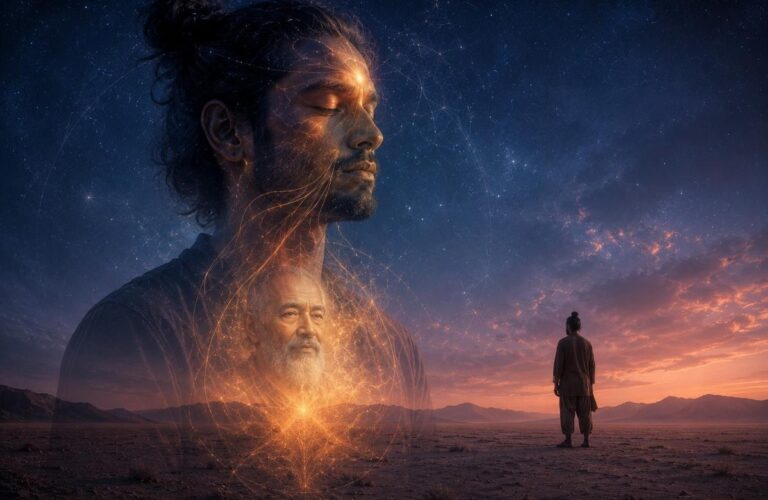
Neo Gnostic Practice: Attention and Digital Discernment
Neo Gnostic practice is not about escaping the world or collecting dramatic symbols. It is the daily work of attention, embodiment, discernment and direct knowing inside modern life. It does not require a monastery, a robe, or a secret initiation. It requires a body, a breath, a moment of stillness, and the willingness to question what you have been told about what is real.
This guide explains how Neo Gnosticism becomes lived practice rather than abstract belief. It moves from the ancient source layer through contemporary application without collapsing the two. Where ancient texts are referenced, they are referenced as sources. Where modern practice is described, it is described as interpretation. The goal is not to reconstruct ancient ritual but to recover the orientation that made ancient ritual meaningful: the turn toward direct knowing, the clearing of false identity, and the recognition of the hidden light within.

In Plain Terms
Neo Gnostic practice is the disciplined work of turning attention inward, recognising the divine spark within the body, and testing every inner and outer claim against direct experience. It includes contemplation, breath, body awareness, study of ancient texts, digital minimalism, shadow work, and the ethical testing of insight in daily life.
Unlike some spiritual systems that promise dramatic transformation, Neo Gnostic practice is deliberately ordinary. It happens in the quiet room, the morning commute, the pause before speaking, the breath before sleep. It is not theatrical. It is not performative. It is the steady cultivation of a capacity that most modern conditions are designed to erode: the capacity to pay attention to what is actually happening, inside and outside, without the mediation of algorithm, ideology, or habit.
Modern Companion: Counterfeit-Spirit Discernment
For the discernment warning beneath this practice route, read Neo Gnosticism and the Counterfeit Spirit. That companion article examines false awakening, spiritual performance, symbolic overload, machine-shaped authority and the subtle ways practice can imitate liberation while preserving bondage.
For the companion layer on teachers, algorithms, platforms, groups and machines that try to become final interpreters, read Neo Gnosticism and False Authority. That guide shows how practice weakens when a seeker lets an external voice steal the work of direct knowing.
Neo Gnostic practice is strongest when it remains ordinary, embodied and ethically testable. When practice becomes image, identity, superiority or spiritual outsourcing, the counterfeit has put on a cleaner robe.
Primary Sources and Traditions Discussed
- The Nag Hammadi Library: thirteen codices containing forty-six tractates, the primary source layer for ancient Gnostic contemplative and ritual practice.
- The Gospel of Thomas: a sayings gospel presenting Jesus as a teacher of hidden knowledge, central to contemplative reading practice.
- The Gospel of Philip: a Valentinian text on sacrament, eros and the bridal chamber, relevant to embodied practice and relational discernment.
- The Apocryphon of John: a Sethian creation myth describing the five seals, anointing and ascent practices.
- Valentinian and Sethian traditions: differing ancient approaches to ritual, sacrament and the transformation of consciousness.
- Hermeticism: the Corpus Hermeticum, with its emphasis on divine mind, contemplation and the regeneration of the soul.
- Jungian depth psychology: active imagination, shadow work and the individuation process as modern parallels to Gnostic transformation.
- Contemplative traditions: Buddhist vipassana, Christian lectio divina, and yogic nyasa as technical resources for attention and embodiment.
- Digital minimalism and attention restoration: contemporary disciplines for reclaiming attention from algorithmic capture.
How to Read This Article
This article is practical. It describes what Neo Gnostics do, not merely what they believe. Each section can be read independently, though together they form a coherent picture of the Neo Gnostic practice landscape. If you are new to this material, begin with the sections on attention and embodiment. If you are already practising, the sections on digital discernment and shadow work may offer the most contemporary relevance.
The article is not a prescription. It is a description of what works, drawn from ancient sources, modern psychology, and the lived experience of contemporary practitioners. Test everything against your own direct experience. Discard what does not serve. Keep what does.
Table of Contents
- What Is Neo Gnostic Practice?
- Practice Is Not Escape
- Attention: The First Practice
- Embodiment: Returning Gnosis to the Body
- Discernment: Testing Inner and Outer Authority
- Study: Reading Ancient Texts Without Becoming Abstract
- Digital Discernment: Screens, Algorithms and Attention Capture
- Shadow Work: The Trap of Feeling “More Awake”
- Practice, Performance and the Counterfeit Spirit
- False Authority and the Theft of Practice
- A Simple Daily Neo Gnostic Practice
- Common Mistakes
- Ancient Practice and Modern Practice Compared
What Is Neo Gnostic Practice?
Neo Gnostic practice is the disciplined cultivation of direct knowing within the conditions of modern life. It is not a single technique but a family of practices that share a common purpose: to clear the field of perception so that the divine spark can recognise itself.
The ancient texts describe rituals that were understood as technologies of transformation. The five seals, baptism, anointing, the bridal chamber–these were not empty ceremonies. They were understood to effect real change in the soul’s orientation. Modern Neo Gnostics do not typically reconstruct these rituals in their ancient form. Instead, they adapt the underlying principles into contemporary practice: attention, breath, body awareness, contemplative reading, digital minimalism, shadow work, and ethical testing in daily life.
What unites these practices is their purpose. They are not methods for acquiring supernatural powers. They are not techniques for escaping the world. They are preparations for recognition. The practitioner does not create the divine spark. She uncovers it. She does not build the kingdom. She notices that it is already present. The practice is the clearing, not the construction.
Practice Is Not Escape
One of the most common misunderstandings of Gnostic practice is that it is about escaping the material world. Some ancient texts do express hostility toward the body and the cosmos. The Sethian tradition, in particular, describes the material world as a prison fashioned by the ignorant Demiurge and his archontic administrators. But this is not the whole picture.
The Valentinian tradition–one of the most sophisticated branches of ancient Gnosticism–had a more nuanced view. Valentinus taught that the material world was created in ignorance but still contained traces of the divine light. The body was not evil; it was mixed. The spiritual work was not to destroy the body but to transform it, to redeem the flesh through gnosis and sacrament.
Modern Neo Gnostics generally reject world-escape. They recognise that the body is the vehicle through which gnosis is experienced. The world is the field in which awakening happens. The question is not whether to have a body but whether to be conscious within it. The question is not whether to live in the world but whether to see through its constructed surfaces to what lies beneath.
Practice is therefore worldly. It happens in the kitchen, the office, the bedroom, the street. It is the discipline of attention in a world designed to capture it. It is the discipline of embodiment in a culture that privileges abstraction. It is the discipline of discernment in an information ecology that profits from confusion. The practitioner does not leave the world. She changes her relationship to it.
Attention: The First Practice
Attention is the foundation of all Neo Gnostic practice. Without it, nothing else is possible. Contemplation, study, body awareness, and discernment all depend on the capacity to direct and sustain attention without being captured by distraction.
The ancient Gnostics understood this. The Gospel of Thomas records Jesus saying, “The kingdom is inside you and it is outside you.” Recognition of this kingdom requires attention. It requires the capacity to notice what is present rather than what is advertised. It requires the willingness to be still in a world that rewards motion.
Modern conditions make attention extraordinarily difficult. The digital environment is architected to prevent sustained focus. Notifications, feeds, algorithms, and infinite scroll are designed to capture and fragment attention for commercial purposes. Research in environmental psychology distinguishes between directed attention–the effortful, depleting focus required by modern tasks–and soft fascination, the gentle, restorative attention invited by natural environments. Without periods of undirected attention, the brain experiences attentional fatigue: cognitive resources deplete, and the capacity for deep reflection collapses.
The Neo Gnostic response is not Luddite rejection but disciplined subtraction. Digital minimalism–the deliberate reduction of informational input–is not a moral posture but a technical specification for cognitive hygiene. The device removed from the bedroom. The notification silenced. The scroll interrupted. The threshold of boredom, crossed repeatedly, reveals itself as a threshold of attention: the point where interior signal strengthens enough to be heard above the static of consensus.
Specific attention practices include:
Sitting meditation. The simple practice of sitting still, attending to the breath, and allowing the surface noise of mind to settle. This is not about achieving bliss or escaping difficulty. It is about creating the conditions under which direct knowing becomes possible. Begin with ten minutes. Extend gradually. Quality matters more than duration.
Contemplative reading. The slow, receptive reading of a short text–a saying from the Gospel of Thomas, a passage from the Gospel of Philip, a paragraph from a scholarly commentary–allowing the words to work on attention rather than being consumed as information. Read once. Pause. Read again. Notice what resonates. Do not rush to interpretation.
Transition practice. Using the natural transitions of the day–waking, eating, walking, sleeping–as cues to return attention to the body and breath. The doorway becomes a bell. The transition becomes practice. The ordinary day, segmented by attention, becomes the training ground.
Embodiment: Returning Gnosis to the Body
The body is not an obstacle to Gnosis. It is the instrument through which Gnosis is experienced. This is a central conviction of modern Neo Gnostic practice, and it marks a significant departure from some ancient texts that treated the body with suspicion or hatred.
Embodiment practice means returning attention to the physical sensations of the body: pressure, temperature, vibration, tension, ease, pain, release. It means noticing the breath as it moves through the nostrils, chest, and abdomen. It means feeling the feet on the floor, the weight of the body in the chair, the contact of skin with air. These are not mystical experiences. They are ordinary experiences, made conscious.

The body scan is a foundational technique. The practitioner, lying or sitting, directs attention sequentially through the body–feet, legs, pelvis, abdomen, chest, back, shoulders, arms, hands, neck, face, head. Each region, attended, reveals sensation. The observation, sustained, produces change–not through manipulation but through awareness itself. The body, attended, relaxes. The mind, focused on sensation, stills. The stillness, prolonged, produces altered state.
Somatic awareness extends the body scan into daily life. Walking, the feet contact ground. Eating, taste and texture register. Working, posture and tension are noted. The awareness, continuous, produces embodied presence–the person here, now, in flesh, not dissociated into thought or fantasy. This continuity interrupts what might be called the default mode of dissociation: the habitual withdrawal of attention from body into digital environment, narrative memory, or speculative future that characterises contemporary consciousness.
Movement is also embodiment practice. The body, calibrated through regular sleep, natural light, simplified food, and daily movement, becomes transparent. When the noise of fatigue and agitation diminishes, the interior signal strengthens. The body becomes the stable platform from which attention can extend without dissipation.
Discernment: Testing Inner and Outer Authority
Discernment is the capacity to distinguish genuine insight from projection, fantasy, manipulation, inflation, fear, or borrowed belief. It is perhaps the most important practice in Neo Gnosticism, and the most difficult.
The ancient Gnostics placed enormous emphasis on discernment. The archons–the powers that govern the lower world and obstruct the soul’s awakening–are not merely external forces. They are also internal: the voices of fear, shame, conformity, and false identity that keep consciousness obedient to illusion. To recognise the archons is to recognise these voices for what they are: limited, derivative, and dependent on ignorance for their power.
Modern Neo Gnostics practise discernment on multiple levels. On the inner level, they question their own motives, beliefs, and emotional reactions. Is this insight genuine, or is it the ego seeking confirmation? Is this feeling authentic, or is it a conditioned response? Is this intuition clear, or is it contaminated by desire or fear?
On the outer level, they question the claims of teachers, traditions, institutions, and media. Does this teaching lead to direct knowing or to dependence? Does this institution serve awakening or control? Does this information clarify or confuse? The Neo Gnostic does not reject authority outright. She tests it. She holds it up to the light of her own direct experience and watches what remains.

Specific discernment practices include:
The waiting period. Do not act on insights immediately. Wait twenty-four hours. Wait a week. Test the insight against sleep, against disagreement, against the ordinary demands of daily life. What survives is worth keeping. What dissolves was never solid.
The ethical test. Does this insight make you more truthful, more compassionate, more discerning? Or does it make you superior, contemptuous, withdrawn? Genuine gnosis produces humility and clarity. Inflation produces arrogance and fragmentation.
The body test. Does this insight resonate in the body as well as the mind? The body often knows before the mind admits. Tension, relaxation, expansion, contraction–these are physiological signals of truth and falsehood. Learn to read them.
Study: Reading Ancient Texts Without Becoming Abstract
Study is practice when it is done correctly. The Neo Gnostic does not read the Nag Hammadi texts as historical curiosities or as ammunition for arguments. She reads them as mirrors: texts that reflect her own condition back to her with a precision that no modern self-help book has achieved.
The Gospel of Thomas is particularly suited to this approach. Its 114 sayings are short, paradoxical, and dense. They do not explain. They provoke. Read slowly. Read one saying per day. Read it aloud. Read it before sleep. Read it upon waking. Notice which sayings resonate and which resist. The resonance is recognition. The resistance is also information–it marks the boundary of your current understanding.
The Apocryphon of John offers a different kind of study. Its elaborate cosmology–the Pleroma, the fall of Sophia, the birth of Yaldabaoth, the creation of the archons, the fashioning of the material body–can be read as myth, as psychology, or as metaphysics. The modern reader does not need to accept it as literal history. She needs to ask: does this map describe something real about my experience? Does the figure of the Demiurge illuminate something about the structures that shape my perception? Does the divine spark describe something I have felt but could not name?
Study should be balanced with practice. Reading without practice produces intellectual inflation–the sense that knowing about gnosis is the same as having gnosis. Practice without study produces idiosyncrasy–the sense that your personal experience is the whole of the tradition. The two correct each other. Study provides the map. Practice provides the territory. The map is not the territory. But without the map, the territory is harder to navigate.
Digital Discernment: Screens, Algorithms and Attention Capture
Perhaps the most distinctive feature of contemporary Neo Gnostic practice is its engagement with digital technology. Ancient Gnostics faced the archons of planetary fate and imperial power. Neo Gnostics face the archons of algorithmic governance, surveillance capitalism, and artificial intelligence.
Algorithms sort, rank, predict, and recommend. They shape what billions of people see, think, and desire. They operate invisibly, without consent, and with a logic optimised for engagement rather than wisdom. In this sense, they are archonic: they administer a reality they do not understand, enforcing patterns of behaviour that serve the system rather than the soul.
The Neo Gnostic response is not rejection but discernment. The question is not whether to use technology but how to use it without being used by it. Digital minimalism, attention sovereignty, and algorithmic literacy become spiritual practices.

Specific digital discernment practices include:
The device boundary. Remove devices from the bedroom. Do not check the phone upon waking. Do not check it before sleep. These are not moral rules. They are technical specifications for protecting the attention during its most vulnerable periods.
The notification fast. Turn off all non-essential notifications. The constant ping of attention capture is not a convenience. It is a training regimen for fragmentation. Reclaim the right to be interrupted only by what you choose.
The scroll interruption. When you notice yourself scrolling, stop. Ask: what am I looking for? If the answer is distraction, put the device down. If the answer is information, search for it directly. Scrolling is not seeking. It is surrender.
The algorithmic audit. Periodically review what the algorithms are showing you. Are your feeds narrowing or expanding? Are they confirming your biases or challenging them? The algorithm is not neutral. It is a curator with commercial interests. Treat it as such.
The screen Sabbath. One day per week without screens. Not as punishment. As restoration. The attention, freed from digital capture, returns to the body, to the natural world, to the face-to-face encounter. The transformation is not dramatic. It is subtle. It is the difference between a room with the window open and a room with the window closed.
Shadow Work: The Trap of Feeling “More Awake”
One of the most dangerous traps in spiritual practice is the inflation that follows initial insight. The practitioner has a genuine experience of recognition. She sees through the constructed world. She feels the divine spark. And then she assumes that this insight makes her superior to those who have not had it.
This is the shadow side of gnosis. The ancient Gnostics were not immune to it. The threefold anthropology–hylic, psychic, pneumatic–could become a tool of spiritual snobbery. The pneumatic, or spiritual person, might look down on the hylic, or material person, as inferior. The critique of the Demiurge could become a blanket contempt for the material world and those who live in it unreflectively.
Modern Neo Gnostics must be vigilant against this inflation. Shadow work–the disciplined excavation of repressed emotions, fears, desires, and projections–is essential. The practitioner who feels “more awake” than others is probably less awake than she thinks. Genuine gnosis produces humility, not superiority. It produces compassion, not contempt. It produces clarity, not conspiracy.
Specific shadow work practices include:
Journaling. Write daily, not about insights but about reactions. What annoyed you today? Whom did you judge? What fear surfaced? What desire was denied? The shadow lives in the unexamined reaction. Bring it to light.
Projection tracking. Notice when you attribute negative qualities to others. The person who irritates you is often carrying your own disowned shadow. The quality you despise in them is often the quality you fear in yourself. This is not a New Age slogan. It is a psychological law, confirmed by depth psychology and lived experience.
The humility check. Ask regularly: has my practice made me kinder? Has it made me more truthful? Has it made me more available to others? Or has it made me more withdrawn, more critical, more convinced of my own specialness? The answer is information. Act on it.
Practice, Performance and the Counterfeit Spirit
Every practice can be imitated. Attention can become self-monitoring. Embodiment can become a spiritual aesthetic. Digital minimalism can become superiority. Study can become concept collecting. Shadow work can become another identity to display. None of these distortions make practice worthless, but they show why discernment must remain close.
This is the warning explored in Neo Gnosticism and the Counterfeit Spirit: false awakening often imitates the outer shape of growth while leaving the deeper bondage untouched. It may speak the language of gnosis, trauma, embodiment, energy, sovereignty or healing, yet still produce performance, dependency, inflated identity or avoidance of ordinary responsibility.
Practice becomes counterfeit when it improves the spiritual costume while leaving the old bondage in charge.
The test is fruit. Does the practice make the person more truthful, embodied, patient, compassionate and available to ordinary life? Or does it make them more theatrical, dependent, superior, reactive or eager to be seen as awake? The genuine practice does not need constant display. It deepens quietly and proves itself in how the person lives.
| Genuine practice | Counterfeit practice |
|---|---|
| Returns attention to body, breath and ordinary life. | Turns practice into identity, image or spiritual theatre. |
| Can be tested by patience, humility and relationship. | Demands admiration, urgency or special status. |
| Uses tools without surrendering inner authority. | Outsources discernment to teachers, platforms, systems or machines. |
| Loosens fear, compulsion and false identity over time. | Repackages fear and compulsion as revelation. |
False Authority and the Theft of Practice
Practice also becomes distorted when guidance becomes capture. A teacher, group, tradition, platform, AI adviser or spiritual brand may begin as a useful support, then slowly become the final interpreter of the seeker’s inner life. This is false authority: the moment when a guide no longer points back to direct knowing but asks the seeker to surrender the light by which guidance should be tested.
False authority does not always arrive as domination. It may arrive as certainty, diagnosis, belonging, special status, a perfect technique, a polished community or a machine answer that sounds wiser than the body feels. It offers relief from uncertainty, but the price is dependence. The seeker no longer asks what is true. They ask what the system, teacher, platform or oracle says is true.
This is why Neo Gnosticism and False Authority belongs beside this practice guide. The counterfeit spirit names imitation awakening. False authority names the outer structure that often sustains that imitation: the guru, feed, machine, institution or identity that becomes a substitute for direct knowing.
- Healthy guidance strengthens attention, embodiment, ethical responsibility and the courage to test.
- False authority weakens those capacities by making the seeker dependent on an external interpreter.
- Genuine practice can receive help without handing over the compass.
The guide is useful only while it returns the seeker to the light by which guidance is tested.
A Simple Daily Neo Gnostic Practice
Practice does not need to be elaborate. It needs to be consistent. Here is a simple daily structure that integrates the elements described above.
Morning (ten minutes). Upon waking, before checking any device, sit quietly. Attend to the breath for five minutes. Read one saying from the Gospel of Thomas. Sit with it for five minutes. Do not interpret. Simply notice what resonates.
During the day (scattered moments). Use transitions as cues for body awareness. When standing from a chair, feel the feet. When closing a laptop, notice the shoulders. When eating, taste the food. These are micro-practices. Their cumulative effect exceeds their individual weight.
Evening (fifteen minutes). A brief body scan, moving attention from feet to head. Then journaling: three things noticed, one reaction examined, one question held. The journal is not a record of insights. It is a record of attention.
Weekly (one hour). A longer session of contemplative reading, walking meditation, or silent sitting. One day per week with reduced screen time. One conversation per week in which you practise listening without preparing your response.

This is not a demanding schedule. It is a sustainable rhythm. The goal is not intensity but continuity. The spark is uncovered not by dramatic effort but by steady attention. The transformation is complete when it is no longer visible as transformation. You simply live differently. The recognition, embodied in this different living, is recognised by others who are ready.
Common Mistakes
Neo Gnostic practice, like any practice, is vulnerable to distortion. Here are the most common mistakes.
Intellectualism without practice. Reading the Nag Hammadi texts, debating cosmology, and collecting concepts without ever sitting still, attending to the body, or testing insight in daily life. This is not gnosis. It is hobbyism.
Escapism. Using practice as a way to avoid responsibility, relationship, work, or difficulty. The practitioner who retreats into meditation to avoid a difficult conversation is not practising gnosis. She is practising avoidance.
Inflation. Assuming that initial insights confer special status. The “more awake” trap. The spiritual superiority complex. The contempt for ordinary people. These are signs not of advancement but of regression.
Conspiracy thinking. Using the language of archons and the Demiurge to justify paranoia about governments, corporations, or other groups. The archons are patterns of power, not personal enemies. Discernment is not suspicion.
Perfectionism. Abandoning practice because you missed a day, had a distracted session, or failed to achieve a particular state. Practice is not performance. It is presence. The distracted session is still practice. The missed day is still part of the rhythm. Begin again.
Ancient Practice and Modern Practice Compared
Neo Gnostic practice differs from ancient Gnostic practice in form, setting and available tools. The underlying orientation remains similar: direct knowing, liberation from false authority, and the recovery of the hidden light within the human being.
| Area | Ancient Gnostic Practice | Neo Gnostic Practice |
|---|---|---|
| Social setting | Often communal, embedded in initiatory circles, churches, teacher-student relationships or ritual communities. | Often solitary, loosely affiliated or online, requiring the practitioner to build a reliable container for study and practice. |
| Access to texts | Texts were scarce, copied by hand, guarded by communities and interpreted within living ritual contexts. | Texts are widely available through translations, printed editions and online archives, which increases access but can flatten context. |
| Ritual form | Baptism, anointing, sacramental meals, the bridal chamber, the five seals and visionary ascent. | Contemplation, breath, body awareness, study, journaling, digital discernment, ethical testing and grounded integration. |
| Authority | Teachers, lineages, texts and initiatory structures helped guard and transmit the practice. | Discernment, personal testing, careful reading and community feedback become especially important. |
| Technological context | The practitioner faced empire, temple, social fate and mythic planetary powers. | The practitioner faces screens, feeds, platforms, algorithmic capture and machine-mediated authority. |
| Core aim | Liberation through gnosis from cosmic fate, false rule and forgetfulness. | Recognition through gnosis inside modern life, amid systems, identity, distraction and mediated attention. |
The form has changed. The centre has not. Whether through ancient ritual or modern meditation, communal sacrament or solitary contemplation, cosmic ascent or digital minimalism, the aim is direct knowing: the recognition of the divine spark and liberation from the powers that obscure it.
Related Glossary Terms
These ZenithEye articles and glossary-style guides illuminate the terms discussed in this article:
Gnosis – Direct, transformative knowing that changes the one who recognises.
Divine Spark – The hidden light within the human being that remembers its origin beyond the lower world.
Archons – Ruling powers or structures that shape perception and obstruct awakening.
Demiurge – The lower craftsman or world-maker in Gnostic myth and modern symbolic reading.
Pleroma – Divine fullness, the higher source from which the spark originates.
Kenoma – The lower realm of deficiency, limitation and forgetfulness.
Aeon – A divine emanation, power or principle within the Pleroma.
Sophia – Divine Wisdom, the fallen and restored figure whose drama explains the origin of the lower world.
Counterfeit Spirit – False animation, imitation life or unconscious pattern mistaken for true spirit.
False Awakening – The appearance of spiritual progress without genuine liberation, humility or integration.
Spiritual Performance – The use of spiritual language, image or practice to display identity rather than deepen truth.
Pattern Addiction – Compulsive interpretation of signs, symbols and repetitions without grounding or patient testing.
Symbolic Overload – The condition in which symbols, feeds, dreams or images become too charged to hold with proportion.
Spiritual Outsourcing – Surrendering inner discernment to teachers, platforms, machines, systems or borrowed authority.
False Authority – A teacher, system, platform, machine or group that asks the seeker to surrender direct knowing.
Machine Authority – The temptation to treat automated fluency as wisdom, judgement or final guidance.
Authority Capture – The process by which guidance becomes dependence and the guide becomes the gate.
Read Next
Continue with the practical and Neo Gnostic routes most closely connected to this article:
- Neo Gnosticism and the Counterfeit Spirit – The discernment companion for false awakening, spiritual performance, symbolic overload and practice that imitates liberation without freeing the seeker.
- Neo Gnosticism and False Authority – The companion guide to gurus, algorithms, AI advisers, spiritual outsourcing and the theft of direct knowing.
- The 5 Gateways to Direct Knowing – The wider practical map for reducing noise, stabilising attention and entering direct recognition.
- Gateway of Sensation: Body Scan and Somatic Awareness – The foundational practice for reclaiming the felt sense of the body.
- Digital Minimalism as Mystical Practice – A companion guide to attention, subtraction and the recovery of inward space.
- What Do Neo Gnostics Believe? – The belief-map behind direct knowing, the divine spark, archons, the Demiurge, Jesus, the body, technology and practice.
- Is Neo Gnosticism a Religion, Philosophy or Practice? – Why Neo Gnosticism can take several forms while gnosis remains the centre.
- Neo Gnosticism vs Ancient Gnosticism – What changed, what remained and how modern Gnosis differs from the ancient Gnostic path.
Neo Gnosticism Route
The Neo Gnosticism Route
This article belongs to ZenithEye’s Neo Gnosticism route: a reader pathway through modern Gnostic revival, direct knowing, digital authority and the contemporary return of ancient wisdom.
- Open the Neo Gnosticism hub
- What Is Neo Gnosticism?
- What Do Neo Gnostics Believe?
- Is Neo Gnosticism a Religion, Philosophy or Practice?
- Neo Gnosticism vs Ancient Gnosticism
- Neo Gnostic Practice: Attention, Embodiment and Digital Discernment – You are here.
- Digital Archons: How Algorithms Shape Attention
- Neo Gnosticism and the Counterfeit Spirit
- Neo Gnosticism and False Authority
- How Gnosticism Survived 2,000 Years
- Who Are the Neo Gnostics?
- Living Gnosis
- Transhumanism as Neo Gnosticism
Follow the route from definition through belief, classification, comparison, practice, digital authority, counterfeit-spirit discernment, false authority, history, identity, daily life and the body-technology debate.
Frequently Asked Questions
What is Neo Gnostic practice?
Neo Gnostic practice is the disciplined cultivation of direct knowing within modern life. It includes attention training, body awareness, contemplative reading, digital minimalism, shadow work and ethical testing of insight in daily life. It is not about escaping the world but about recognising the divine spark within the body and seeing through the constructed surfaces of ordinary reality.
Do I need to join a church or group to practise Neo Gnosticism?
No. Neo Gnostic practice can be done alone. Many practitioners are solitary seekers who read the Nag Hammadi texts, practise meditation and body awareness, and test their insight in daily life. Community can still be valuable for testing, mutual recognition and grounding, but there is no requirement to join an institution.
How do I start a daily Neo Gnostic practice?
Begin simply. Sit for ten minutes before checking any device. Attend to the breath. Read one short passage from a Gnostic text, such as the Gospel of Thomas, and sit with it without rushing to interpretation. During the day, use transitions as cues for body awareness. In the evening, practise a short body scan and write down what you noticed.
Is the body important in Neo Gnostic practice?
Yes. Modern Neo Gnosticism generally treats the body as the field where recognition must become real. Breath, sensation, posture, movement, rest and emotional honesty are all part of practice. Embodiment helps prevent gnosis from becoming abstract, inflated or disconnected from ordinary life.
What is digital discernment in Neo Gnostic practice?
Digital discernment is the practice of reclaiming attention from algorithmic capture. It can include removing devices from the bedroom, turning off non-essential notifications, interrupting compulsive scrolling, auditing algorithmic feeds and observing screen-free periods. The goal is not to reject technology, but to use it without being used by it.
Why does shadow work matter in Neo Gnostic practice?
Shadow work matters because spiritual insight without self-examination can produce arrogance, bypassing and contempt. The practitioner may feel more awake while remaining governed by fear, projection or superiority. Shadow work keeps the practice honest by testing insight against humility, compassion, truthfulness and embodied change.
How does Neo Gnostic practice differ from ancient Gnostic practice?
Ancient Gnostic practice was often communal, ritual-based and embedded in initiatory circles with scarce texts. Modern Neo Gnostic practice is often more solitary, portable and adapted to digital conditions. The form has changed, but the aim remains direct knowing, the recognition of the divine spark and liberation from false authority.
How can Neo Gnostic practice become counterfeit?
Neo Gnostic practice becomes counterfeit when attention, embodiment, study, digital minimalism or shadow work turns into spiritual performance, superiority, dependency or avoidance. The test is fruit: genuine practice deepens humility, embodiment, compassion, discernment and ordinary responsibility, while counterfeit practice preserves bondage in a more spiritual form.
How does false authority distort Neo Gnostic practice?
False authority distorts Neo Gnostic practice when a teacher, group, platform, AI adviser, method or spiritual brand becomes the final interpreter of direct knowing. Healthy guidance strengthens discernment and releases the seeker. False authority creates dependence, fear, specialness or obedience, and turns practice into submission rather than recognition.
Further Reading
Explore these ZenithEye articles to deepen your understanding of Neo Gnostic practice, attention, embodiment, digital discernment and contemporary spiritual discipline.
- Neo Gnosticism and the Counterfeit Spirit – The modern discernment companion on false awakening, spiritual performance and practice that becomes imitation rather than liberation.
- Neo Gnosticism and False Authority – The companion guide to false teachers, machine authority, spiritual outsourcing and the theft of direct knowing.
- The 5 Gateways to Direct Knowing – The wider practical map for reducing noise, stabilising attention and entering direct recognition.
- Gateway of Sensation: Body Scan and Somatic Awareness – The foundational practice for reclaiming the felt sense of the body.
- Digital Minimalism as Mystical Practice – Strategies for reducing digital noise and restoring contemplative awareness.
- The Quantified Soul – A critical look at wellness culture, measurement and the temptation to turn healing into self-surveillance.
- States of Knowing – A study of non-ordinary states and their integration into ordinary life.
- Living Gnosis – Practical guidance for maintaining Gnostic discernment in everyday life, work, relationships and digital culture.
References and Sources
This article draws upon primary sources from the Nag Hammadi Library, scholarly reconstructions of ancient Gnosticism, contemporary psychology and the lived experience of modern practitioners. The following sources represent the core reference layer.
Primary Sources and Critical Editions
- Robinson, J. M. (ed.). (1990). The Nag Hammadi Library in English (4th revised ed.). HarperSanFrancisco.
- Layton, B. (ed.). (1987). The Gnostic Scriptures: A New Translation with Annotations and Introductions. Doubleday.
- Meyer, M. W. (ed.). (2007). The Nag Hammadi Scriptures: The Revised and Updated Translation of Sacred Gnostic Texts. HarperOne.
- Attridge, H. W., and MacRae, G. W. (trans.). (1985). The Gospel of Thomas (NHC II,2) and The Gospel of Philip (NHC II,3). In The Nag Hammadi Library in English.
- Waldstein, M., and Wisse, F. (trans.). (1995). The Apocryphon of John: Synopsis of Nag Hammadi Codex II,1 with BG 8502,2. Brill.
Scholarly Monographs and Interpretive Studies
- King, K. L. (2003). What Is Gnosticism? Harvard University Press.
- Jonas, H. (1958). The Gnostic Religion: The Message of the Alien God and the Beginnings of Christianity. Beacon Press.
- Pagels, E. (1979). The Gnostic Gospels. Random House.
- Turner, J. D. (2001). Sethian Gnosticism and the Platonic Tradition. Presses de l’Universite Laval.
- Brakke, D. (2010). The Gnostics: Myth, Ritual, and Diversity in Early Christianity. Harvard University Press.
Comparative and Contemporary Studies
- Jung, C. G. (1951). Aion: Researches into the Phenomenology of the Self. Routledge and Kegan Paul.
- Hoeller, S. A. (2002). Gnosticism: New Light on the Ancient Tradition of Inner Knowing. Quest Books.
- Leloup, J.-Y. (trans.). (2005). The Gospel of Thomas: The Gnostic Wisdom of Jesus. Inner Traditions.
- Kabat-Zinn, J. (1990). Full Catastrophe Living: Using the Wisdom of Your Body and Mind to Face Stress, Pain, and Illness. Delta.
- Zuboff, S. (2019). The Age of Surveillance Capitalism: The Fight for a Human Future at the New Frontier of Power. PublicAffairs.
Study Note
This article distinguishes ancient sources from modern interpretation. Neo Gnostic practice may draw deeply from ancient Gnostic texts and rituals, but modern adaptations such as contemplation, body awareness, digital minimalism and shadow work should be treated as interpretation, not as direct historical continuity. The purpose of the article is not to reconstruct ancient practice, but to recover the orientation that made it meaningful: the turn toward direct knowing, the clearing of false identity and the recognition of the hidden light within. For the companion warning against practice becoming performance, symbolic overload or false awakening, read Neo Gnosticism and the Counterfeit Spirit. For the outer-authority layer around teachers, platforms, AI advisers and systems that try to become final interpreters, read Neo Gnosticism and False Authority.
Safety Notice: This article explores contemplative and psychological themes related to spiritual awakening, attention, embodiment and systems of control. It does not constitute medical, psychological or spiritual advice. If you are experiencing spiritual emergency, dissociation or psychological distress, please contact a qualified trauma-informed therapist or mental health professional. The practices described here may support reflective study, but they do not replace clinical mental health care. Approach body-based practices gently if you have a history of trauma; intense sensation can release unexpected emotional material. Begin slowly and seek support if needed.