Nag Hammadi Library: The Complete Guide to the 46 Gnostic Scriptures
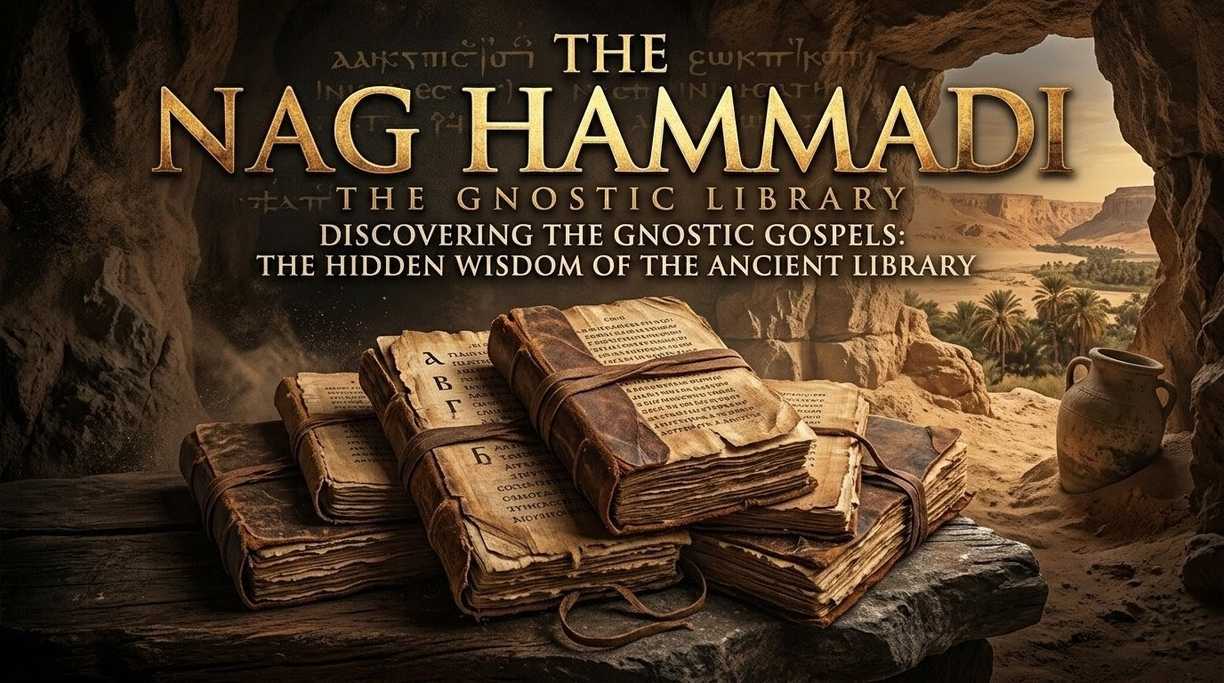
The Nag Hammadi Library stands as the most significant discovery in the history of early Christian studies. Unearthed in December 1945 from the Egyptian desert near the Jabal al-Tarif cliffs, this collection of thirteen fourth-century CE Coptic codices containing forty-six distinct tractates overturned two millennia of theological consensus. For the first time, scholars could hear the Gnostic movement speak in its own voice–not filtered through the polemics of Irenaeus or Tertullian, but through texts like the Apocryphon of John (NHC II,1), the Gospel of Thomas (NHC II,2), and Thunder: Perfect Mind (NHC VI,2). This article offers a complete reader’s guide to the library’s contents, structure, and enduring significance.
Table of Contents
- The Jar Beneath the Cliff: Discovery and Survival
- What Is the Nag Hammadi Library?
- The Thirteen Codices: A Buried Canon
- The Forty-Six Tractates: Mapping the Forbidden
- Why the Nag Hammadi Library Matters
- How to Read the Nag Hammadi Library
- The Living Archive
- Frequently Asked Questions
- Further Reading
- References and Sources

The Jar Beneath the Cliff: Discovery and Survival
The Accidental Archaeologist
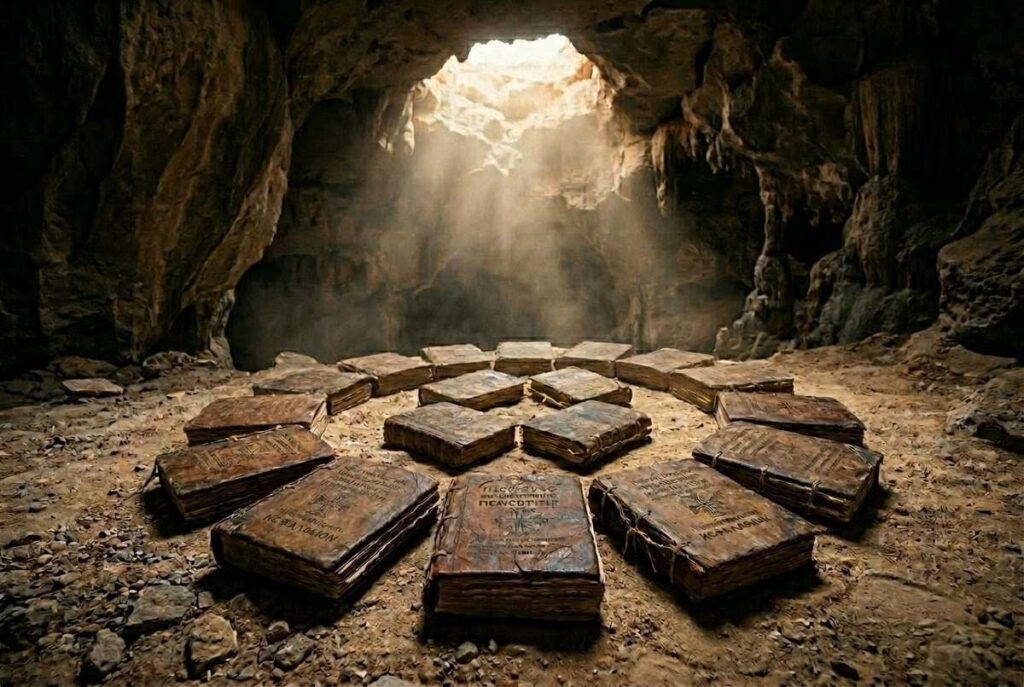
In December 1945, Muhammad Ali al-Samman–an Egyptian farmer seeking revenge against a rival who had murdered his father–dug his pickaxe into a boulder near the base of the Jabal al-Tarif cliffs. The stone broke away, revealing a sealed jar buried in the sand. Fearful of djinn but greedy for treasure, he smashed the container open. Gold did not spill out. Instead, thirteen leather-bound papyrus codices tumbled into the desert air: approximately 1,200 pages of forgotten scripture that would overturn two millennia of Christian administrative history.
The circumstances carry their own irony: an act of personal vengeance unwittingly resurrected texts that spoke of cosmic injustice and the soul’s escape from archonic control. Muhammad Ali later admitted that his mother had burned some pages as kindling–a domestic desecration that nonetheless preserved the majority of the library.
Thirteen Volumes Against Oblivion
This is the Nag Hammadi Library: not a single book, but a buried archive of resistance–forty-six separate tractates written in Coptic during the fourth century CE, containing texts far older than their bindings. Here rest the Gospel of Thomas, the Apocryphon of John, Thunder: Perfect Mind, and dozens of other works deemed heretical by the early Church–works that would otherwise have joined the ashes of the Library of Alexandria in the great bonfire of administrative consensus.
What Is the Nag Hammadi Library?
What Is a Codex?
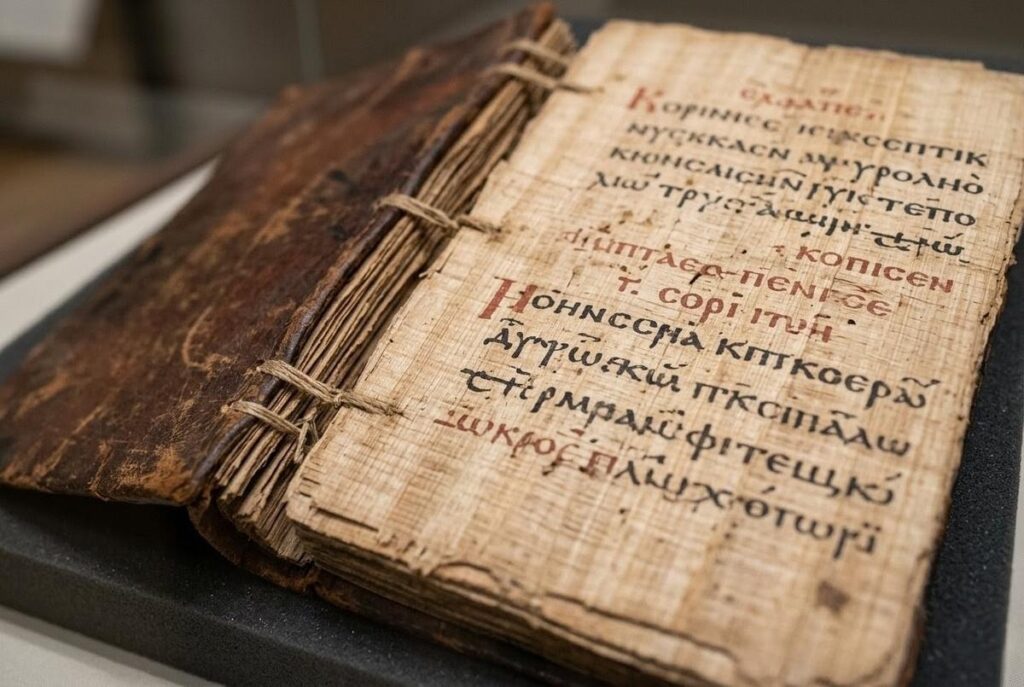
A codex is an ancient book format consisting of folded papyrus sheets sewn along one edge, replacing the scroll. The Nag Hammadi codices use leather covers and cartonnage bindings–a format allowing consultation and concealment under administrative scrutiny.
Scholarly Note on the Library’s Extent: Convention refers to “thirteen codices,” though the find technically comprises twelve bound volumes plus eight loose leaves from a thirteenth text. The collection contains a minimum of 1,240 inscribed pages, of which 1,156 survive in fragmentary or complete form. The count of “forty-six distinct tractates” follows Bart Ehrman’s classification; the standard critical edition edited by James M. Robinson identifies fifty-two separate tractates containing forty-five distinct works once duplicate copies are removed [1][17].
The Gnostic Movement in Exile
The Nag Hammadi Library represents the surviving literature of the Gnostic movement–Christian, Jewish, and pagan mystical traditions systematically suppressed by orthodox authorities between the second and fourth centuries CE. These texts demonstrate that early Christianity was not a monolithic bureaucracy but a marketplace of ideas: Jewish mystics drawing on Merkabah traditions, Platonic philosophers interpreting resurrection as soul-body separation, and women prophets claiming authority denied by canonical epistles. As Karen L. King argues, these texts reveal a spectrum of movements united by gnosis–direct experiential knowledge of the divine–over faith in ecclesiastical authority [7].
Languages of Resistance: Coptic and Greek
The texts are written in Sahidic and Lycopolitan Coptic dialects, with Greek loanwords betraying their Hellenistic origins. Composed in Greek during the first centuries CE and translated into Coptic as Greek literacy declined, they were buried as the final purge of non-orthodox material reached its fourth-century climax under imperial Christian administration.
The Scribes’ Urgent Labour
Codicologically, the library represents fourth-century book production under duress: leather covers, cartonnage bindings from recycled papyrus scraps, and sheets sewn with linen thread. Variations in handwriting suggest a community scriptorium racing to preserve texts before confiscation. The cartonnage contains documentary fragments–tax receipts, letters–providing anchors that place the burial in the mid-fourth century CE during the anti-heretical campaigns of Bishop Athanasius of Alexandria [14].
The Thirteen Codices: A Buried Canon
Each codex tells a story of curation. Someone–perhaps a Pachomian monk fleeing persecution, perhaps a Gnostic Christian community–selected these texts, bound them together, and sealed them beneath the sand:
Primary Source Citation: NHC I,3 16:31-33. The Gospel of Truth describes the terror of separation: “For this reason error became angry with him, pursued him, brought him to those who were her offspring, and afflicted him with all manner of suffering, and fettered him in the forgetfulness of the body.”
The Valentinian Archives: Codices I and XI
Codex I (The Jung Codex) contains the Gospel of Truth, Treatise on Resurrection, and Tripartite Tractate–Valentinian theology at its most refined. Explore Codex I. This codex entered the modern world first, acquired by the Jung Institute before the main discovery. Codex XI continues with Allogenes–describing ascent to the Unknowable One–alongside Hypsiphrone and Interpretation of Knowledge. Explore Codex XI.
The Popular Front: Codices II, III, and IV
Codex II contains the library’s “popular hits”: the Apocryphon of John, Gospel of Thomas, Gospel of Philip, and On the Origin of the World. Explore Codex II. Codex III provides duplicates (Apocryphon of John, Gospel of Egyptians) alongside Eugnostos the Blessed and Sophia of Jesus Christ, suggesting community use. Explore Codex III. Codex IV offers scholarly depth with lengthy versions of Apocryphon of John and Gospel of Egyptians. Explore Codex IV.
Apocalyptic Intelligence: Codex V
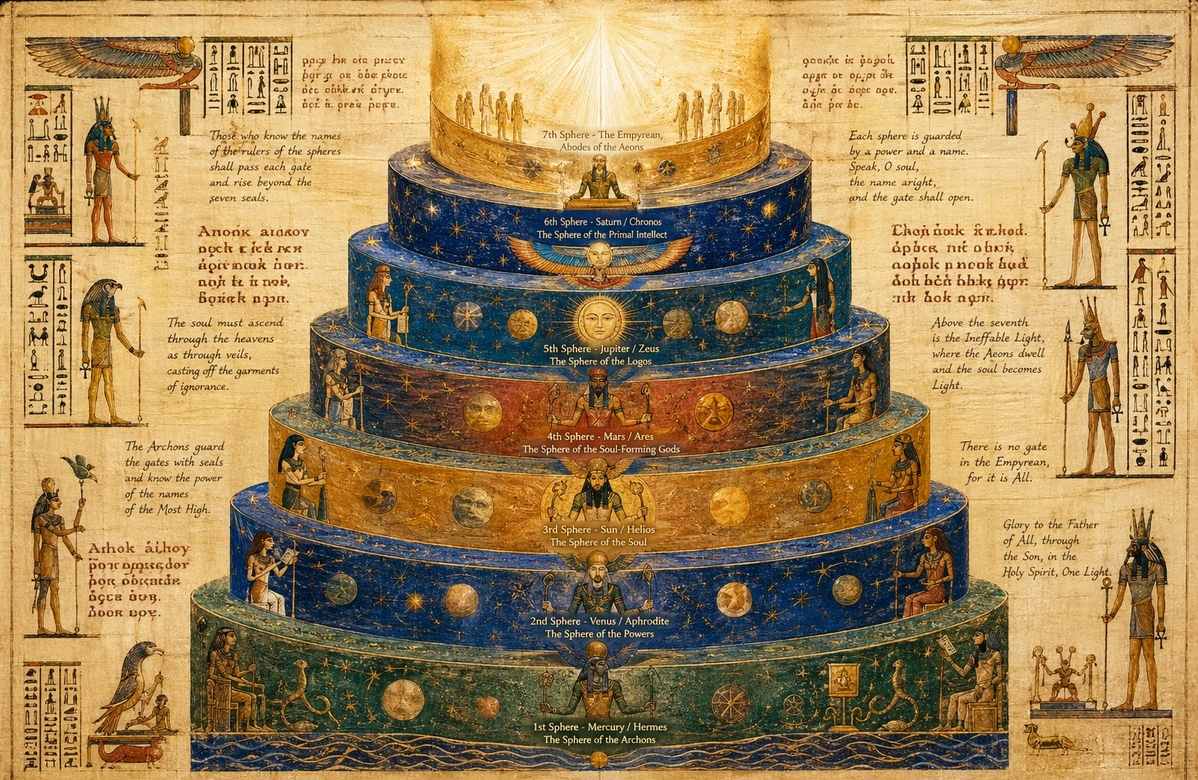
Codex V focuses on revelation literature–Apocalypse of Paul, two Apocalypses of James, and Apocalypse of Adam. These function as leaked intelligence reports from the cosmic bureaucracy, revealing planetary archons and the toll-gates that intercept ascending souls. Explore Codex V.
Hermetic Infiltration: Codex VI
Codex VI demonstrates the library’s intellectual breadth, containing Hermetic and Platonic texts including Plato’s Republic (588A–589B). This reveals that the curators recognised no boundary between “Christian” and “pagan” wisdom. Explore Codex VI.
Sethian Technical Manuals: Codices VII, VIII, and X
Codex VII houses Sethian works: Paraphrase of Shem, Second Treatise of the Great Seth, Apocalypse of Peter, and Teachings of Silvanus. Explore Codex VII. Codex VIII contains Zostrianos (the journey through thirteen aeons) and the Letter of Peter to Philip. Explore Codex VIII. Codex X offers Marsanes–Platonizing Sethian metaphysics at its most abstract. Explore Codex X.
The Warrior Priest and Fragments: Codices IX and XII
Codex IX features Melchizedek (the warrior priest transcending the biblical narrative) and Thought of Norea–a hymn to Eve’s descendant who escapes the archons. Explore Codex IX. Codex XII survives only in fragments, including Gospel of Truth and Sentences of Sextus–Pythagorean wisdom sayings adopted into this collection. Explore Codex XII.
The Feminine Codex: Codex XIII
Codex XIII contains Trimorphic Protennoia–perhaps the most sublime hymn to the divine feminine–describing the Three-Formed First Thought descending through the aeons to awaken her children from ignorance. Explore Codex XIII.
The Forty-Six Tractates: Mapping the Forbidden
Within these thirteen volumes lie forty-six separate works–some duplicates, some unique. They cluster into thematic constellations:
Creation Myths and Cosmological Subversion
The Apocryphon of John (NHC II,1; III,1; IV,1) offers the definitive Gnostic cosmogony–the invisible Spirit, Barbelo the divine First Thought, and the arrogant Demiurge (Yaldabaoth) who fashions the material world as a prison for the divine sparks. Read the Apocryphon of John. On the Origin of the World (NHC II,5) provides an alternative account featuring the cosmic egg and the theft of divine power by archonic administrators. Read On the Origin of the World.
Sayings Gospels: The Thomasine Insurgency
The Gospel of Thomas (NHC II,2)–114 sayings of Jesus without narrative framework–promises that “the kingdom is spread out upon the earth, and people do not see it.” This preserves an alternative Jesus tradition independent of the canonical gospels. Read the Gospel of Thomas.
Primary Source Citation: NHC II,2 77. The Gospel of Thomas preserves the radical immanence of the divine: “It is I who am the light which is above them all. It is I who am the all. From me did the all come forth, and unto me did the all extend. Split a piece of wood, and I am there. Lift up the stone, and you will find me there.”
The Feminine Divine: Thunder and the Bridal Chamber
Thunder: Perfect Mind (NHC VI,2) presents the goddess speaking in paradox: “I am the whore and the holy one. I am the wife and the virgin… I am the knowledge of my inquiry, and the finding of those who seek after me.” Read Thunder: Perfect Mind. The Gospel of Philip (NHC II,3) contains the radical theology of the nymphon (bridal chamber), describing spiritual union as the true sacrament obscured by worldly institutions. Read the Gospel of Philip.
Ascent Literature: Bureaucratic Navigation of the Spheres
Zostrianos (NHC VIII,1), Allogenes (NHC XI,3), and Marsanes (NHC X,1) function as technical manuals for the soul’s journey through planetary spheres and aeonic realms–navigational charts for bypassing cosmic toll-collectors and reaching the Unknowable One. Read Zostrianos.
Primary Source Citation: NHC VIII,1 1:1-5. Zostrianos opens with the protagonist’s crisis: “I came to a great darkness and a deep place, and I could not stand or see anything because of the heavy burden. I turned back so that I might go up and see the light in which I was born.”
Apocalypses: Leaked Intelligence from the Beyond
These heavenly journeys reveal the cosmos: the laughing Saviour of the Apocalypse of Peter (NHC VII,3), who mocks the crucifixion as an illusion; the cosmic toll-gates of the Apocalypse of Paul (NHC V,2); and the secret teachings given to James in the First Apocalypse of James (NHC V,3). Read the Apocalypse of Peter.
Why the Nag Hammadi Library Matters
Speaking from the Ashes
Before 1945, Gnosticism was known primarily through the polemics of its enemies–Tertullian, Irenaeus, Epiphanius–who dismissed these texts as “aberrations.” The Nag Hammadi Library lets the Gnostics speak for themselves, revealing a Christianity far more diverse and philosophically sophisticated than the triumphalist narrative allowed. Elaine Pagels’ groundbreaking work demonstrated that these texts were central participants in the theological debates that shaped Western civilisation [6].
The Diversity Early Orthodoxy Erased
These texts demonstrate that early Christianity was a marketplace of ideas–Jewish mystics drawing on Merkabah traditions, Platonic philosophers interpreting resurrection as soul-body separation, women prophets claiming authority denied by canonical epistles. The library is proof that the victors did not merely win the theological argument; they buried the evidence.
Modern Archons and Ancient Texts
The Nag Hammadi Library is not a museum piece. In an age of algorithmic governance and digital suppression, these texts speak with renewed urgency about autonomy, the deception of authorities, and the divine spark within each consciousness. The archons of antiquity–cosmic administrators who feed on human suffering–find their modern counterparts in systems of control and surveillance. The library’s message remains disturbingly current: the structures that claim to save you may be the very mechanisms of your captivity.
Primary Source Citation: NHC VI,2 13:16-20. Thunder: Perfect Mind declares: “I am the one who is hated everywhere, and who has been loved everywhere. I am the whore and the holy one. I am the wife and the virgin. I am the mother and the daughter.”

How to Read the Nag Hammadi Library
For the newcomer, forty-six ancient texts can overwhelm. We recommend structured approaches:
The Beginner’s Path: From Thomas to the Abyss
Start with the Gospel of Thomas (accessible, poetic, profound), move to the Gospel of Truth (Valentinian mysticism at its most beautiful), then confront the Apocryphon of John (the full Gnostic myth with cosmic tragedy and redemption). Follow the Beginner’s Path.
The Theological Path: Mapping Valentinian and Sethian Territories
Compare the Valentinian Tripartite Tractate with the Sethian Apocryphon of John to understand the two major schools. Examine the Gospel of Philip for sacramental theology and the Hypostasis of the Archons for Sethian cosmology. Follow the Theologian’s Path.
The Mystical Path: Contemplative Engagement with Forbidden Texts
Engage Thunder: Perfect Mind as contemplative poetry. Use Zostrianos as a meditation manual, tracing the protagonist’s ascent as an interior journey. Explore the Hermetic Discourse on the Eighth and Ninth for ecstatic techniques. Follow the Mystic’s Path.
The Living Archive
To read these texts is not merely to study history; it is to join the living thread of forbidden knowing that stretches from the deserts of Egypt to the digital present. The jar is open. The texts have survived. The question remains: who is ready to read them? The Nag Hammadi Library offers the testimony of those who refused to let authorities define the sacred, who preserved their security clearance of gnosis against imperial orthodoxy, and who entrusted their archive to the desert in hope that future generations might recover what the present had forgotten.
Source & Interpretation Note
ZenithEye separates primary sources, scholarly interpretation, symbolic reading and lived contemplative reflection. Ancient texts are treated with care, but not flattened into dogma; modern parallels are offered as interpretive bridges, not proof.
- Editorial Principles — how ZenithEye handles sources, symbolism, AI and lived experience.
- Start Here — the reader guide for the wider archive.
- Site Map & Reading Paths — structured routes through the archive.
Frequently Asked Questions
What is the Nag Hammadi Library and when was it discovered?
The Nag Hammadi Library is a collection of thirteen fourth-century CE Coptic codices discovered in December 1945 near the Jabal al-Tarif cliffs in Upper Egypt. Containing forty-six distinct tractates, these texts preserve Gnostic Christian, Jewish, and Hermetic traditions suppressed by orthodox authorities. The discovery by Muhammad Ali al-Samman ranks among the most significant archaeological finds of the twentieth century, reshaping scholarly understanding of early Christian diversity.
How many texts are in the Nag Hammadi Library?
The Nag Hammadi Library is commonly described on ZenithEye as containing forty-six distinct tractates across thirteen codices, though scholarly counts vary depending on whether duplicate versions and fragmentary texts are counted separately.
What is the difference between the Nag Hammadi Library and the Dead Sea Scrolls?
While both were discovered in the mid-twentieth century in desert environments, they represent entirely different traditions. The Dead Sea Scrolls (discovered 1947–1956 near Qumran) are Jewish texts associated with the Essene community, containing biblical manuscripts and sectarian writings. The Nag Hammadi Library (discovered 1945) is a collection of Gnostic Christian, Hermetic, and Platonic texts buried by fourth-century Egyptian mystics. The Scrolls illuminate Second Temple Judaism; the Nag Hammadi texts reveal the diversity of early Christianity suppressed by orthodox authorities.
Why were the Nag Hammadi texts buried in a jar?
The burial likely occurred during the fourth century CE when imperial Christian orthodoxy began suppressing non-canonical texts. The jar served as both protection and time capsule–sealed against the elements and hidden from ecclesiastical authorities who were confiscating and burning heretical books. The curators intended the texts to survive for future generations during a period of intense religious persecution.
Who were the Gnostics and why did the early Church oppose them?
Gnostics were diverse groups of early Christians, Jews, and pagans who emphasised direct experiential knowledge (gnosis) of the divine over faith in ecclesiastical authority. They typically viewed the material world as flawed or evil, created by a lesser deity (the Demiurge), while the supreme God remained transcendent. Orthodox authorities opposed them for rejecting the goodness of creation, denying physical resurrection, claiming secret knowledge, and granting spiritual authority to women and individuals outside the episcopal hierarchy.
How were the texts preserved for 1,600 years?
The dry desert climate of Upper Egypt provided ideal preservation conditions. Sealed within a buried jar near the Jabal al-Tarif cliffs, the leather-bound papyrus codices were protected from moisture, insects, and human interference. The location–far from the Nile’s flooding–ensured they remained undisturbed until 1945. Some pages were lost to fire and black-market trading, but the majority survived intact.
Which Nag Hammadi text should I read first?
Begin with the Gospel of Thomas–its 114 sayings of Jesus require no prior knowledge of Gnostic cosmology and offer immediate spiritual insight. Next, explore the Gospel of Truth for Valentinian mysticism, then confront the Apocryphon of John for the full cosmic drama. These three texts provide the foundation for understanding the library’s technical ascent literature and Platonic treatises. Follow our curated Beginner’s Path for a structured journey.
Further Reading
These links connect the Nag Hammadi Library to related resources within the ZenithEye library:
- What Is Gnosticism? Defining the Undefinable — Conceptual framework for approaching these texts.
- Gnostic Schools: Sethians, Valentinians, and Hermetics — Guide to the theological traditions represented.
- Nag Hammadi for Beginners: A 10-Text Journey — Curated reading path for newcomers.
- Nag Hammadi for Theologians: A Doctrine-Focused Path — Systematic engagement with Valentinian and Sethian systems.
- The Complete Nag Hammadi Reading Order: All 46 Tractates — Exhaustive sequence for completists.
- Gnostic Technical Glossary: Key Terms from Aeons to Zoe — Essential vocabulary for navigating archonic terminology.
- The Coptic Gnostic Library: Codicology and Conservation — Technical analysis of manuscripts and preservation.
- Timeline of Gnosticism: From Ancient Texts to Modern Discovery — Chronological map to the 1945 unearthing.
- Sethian and Valentinian Traditions in the Nag Hammadi Library — Distinguishing the two major schools.
- The Apocryphon of John: Gnostic Creation Myth and the Fall of Sophia — Deep dive into the library’s most influential cosmological text.
References and Sources
The following sources support the claims and quotations presented in this article. All citations to the Nag Hammadi Library represent direct translations from the Coptic text as established in the standard critical editions.
Primary Sources and Critical Editions
[1] Robinson, James M., ed. The Nag Hammadi Library in English. 4th rev. ed. Leiden: Brill, 1996.
[2] Robinson, James M. The Nag Hammadi Story. 2 vols. Leiden: Brill, 2014.
[3] Layton, Bentley. The Gnostic Scriptures. New York: Doubleday, 1987.
[4] Meyer, Marvin, ed. The Nag Hammadi Scriptures. New York: HarperOne, 2007.
[5] Turner, John D. Sethian Gnosticism and the Platonic Tradition. Leuven: Peeters, 2001.
Scholarly Monographs and Commentaries
[6] Pagels, Elaine. The Gnostic Gospels. New York: Random House, 1979.
[7] King, Karen L. What Is Gnosticism? Cambridge: Harvard University Press, 2003.
[8] Brakke, David. The Gnostics: Myth, Ritual, and Diversity in Early Christianity. Cambridge: Harvard University Press, 2010.
[9] Williams, Michael Allen. Rethinking “Gnosticism”: An Argument for Dismantling a Dubious Category. Princeton: Princeton University Press, 1996.
[10] Logan, Alastair H. B. The Gnostics: Identifying an Early Christian Cult. London: T&T Clark, 2006.
Comparative Studies and Thematic Analyses
[11] Schenke, Hans-Martin. “The Phenomenon and Significance of Gnostic Sethianism.” In The Rediscovery of Gnosticism, ed. Bentley Layton. Leiden: Brill, 1981.
[12] Thomassen, Einar. The Spiritual Seed: The Church of the Valentinians. Leiden: Brill, 2006.
[13] Funk, Wolf-Peter, Paul-Hubert Poirier, and John D. Turner. “The Nag Hammadi Codices and Their Textual Heritage.” In Coptica 7 (2008).
[14] Lundhaug, Hugo, and Lance Jenott. The Monastic Origins of the Nag Hammadi Codices. Tuebingen: Mohr Siebeck, 2015.
[15] Smith, Carl B. No Longer Jews: Not Gentiles Either. Collegeville: Liturgical Press, 2004.